








Efficiency in Hearthstone
Efficiency in Hearthstone
In my last article, I discussed the importance of card advantage. However, it is just as important to make the best use of the cards that you have access to. In some ways, Hearthstone is all about efficiency. You want to draft efficient cards in arena, and play the most efficient cards in constructed. What makes a card efficient? Usually this is a low mana cost for the body or effect of the card. Yet, all of the effort that goes in to evaluating each card’s efficiency and choosing the correct cards for Arena and constructed is pointless if you don’t use the cards efficiently in game. When it comes to being efficient when you are playing the game, the two big concepts are mana efficiency and damage efficiency.
What does it mean to be mana efficient when playing Hearthstone? Simply put, it means using all of your available mana each turn. You will be able to play more cards more quickly if you use your mana well over the course of the game. Being mana efficient will allow you to take better advantage of any card advantage you have gained over the course of the game, as you will be able to deploy those extra minions and spells sooner. It is critical to have a plan for how you will spend your mana each turn, and usually this means thinking about what future turns will look like.
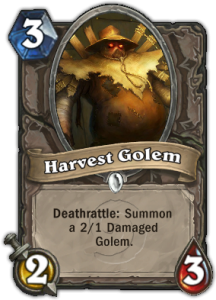 Let’s look at a basic example. It is turn three and your hand is Knife Juggler, Amani Berzerker, Ironfur Grizzly, and Harvest Golem after playing Faerie Dragon on turn 2. You may be tempted to play Knife Juggler so that you can make the most use of his ability with the other minions in your hand. However, the mana efficient play is to choose one of your three cost minions to play this turn. The plan would be to play Ironfur Grizzly now on turn 3, and then on turn four you could play both the Knife Juggler and the Amani Berzerker. If you were to cast the Knife Juggler, you would be forced to play one of your three cost cards on turn 4, leaving you with one less minion overall when you compare the two lines of play.
Things can rapidly change as you draw cards each turn, however. You need to be constantly re-evaluating what the most mana efficient play is, and you should be trying to plan at least one turn in advance. Say you drew a Chillwind Yeti on turn 4 in our example. Now, the best play is likely to drop the Yeti which will allow you to make more use of your Turn 5 mana by playing Harvest Golem and Knife Juggler.
One wrong move in the sequencing can throw off your ability to spend your mana efficiently for the rest of the game.
When deciding between which cards to play on a given turn, one of your first thoughts should be: which cards would let me spend all of my mana this turn, and next? Having this thought in your head, will lead you towards being more mana efficient, and will give you a big advantage as you deploy more cards, more quickly over the course of the game.
Of course there are times when the board will dictate that you can’t make the most mana efficient play. Sometimes you need to play a Frost Bolt on turn 3 to deal with a very troublesome threat, such as a Knife Juggler or Questing Adventurer. When to abandon mana efficiency for the sake of a given situation is one of the harder decisions in Hearthstone play, and one that will take experience to determine the correct play. The key is to know that it is an important decision, and that you are fully aware of how your turns might play out if you make the mana inefficient play.
Another way to be efficient in Hearthstone is with your damage. Damage efficiency is when you deal exactly enough damage to kill a minion in combat or via a spell. You become 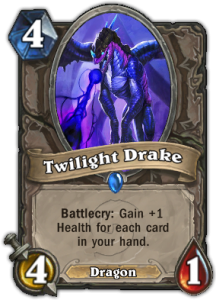 damage inefficient when you deal more damage than is needed to kill a given minion. Let’s say your opponent played an Ironfur Grizzly on turn three. On your turn four, you decide to Fireball the Grizzly. This is a highly inefficient use of Fireball. Yes, you killed the minion, but you have effectively wasted the extra three damage that Fireball did to it. What happens when your opponent plays a six toughness Twilight Drake the following turn? Now you might not have the minions or spells that can deal with it efficiently. Now you might have to use a Frost Bolt and attack a 3 power minion into the Drake to take it down. You just gave your opponent a 2 for 1! If you read my previous article, you know that this is a sure-fire way to lose games.
Often, it won’t be immediately obvious that your damage efficiency matters. Like in the example above, how could you have known he was going to play a 6 toughness minion the next turn? It is for this reason that you sometimes need to be patient and wait to use your spells or minions for when they can be more damage efficient. You often don’t know what is coming, so you need to make a conscious effort to keep damage efficiency in mind as you play the game so that you give yourself the chance to be efficient in the future.
In Hearthstone, once you have a minion in play and ready to attack, it essentially functions like a damage spell such as Frost Bolt or Fireball. You need to use your minions’ damage efficiently over the course of the game in order to make favorable trades and to both gain card advantage and deny it to your opponent.
Of course there will be situations where you need to be damage inefficient in order to deal with a threat that you have no other answers to. Similar to mana efficiency, it will take experience to learn when it is correct to throw efficiency to the wind in order to meet a strategic end. In general, you should start with the baseline of trying to be damage efficient whenever possible and adjust as you gain more experience.
A final note on efficiency is that you should always look to make efficient trades of cards. This means that ideally you want to use a card that cost the same or less mana to destroy a card of your opponent’s. “Trading up” means to use your cheaper card to destroy an opponent’s more expensive card. Doing so will typically gain you a “mana advantage” over your opponent which will allow you to get ahead on the board. Usually you will be trading cards that cost the same amount.
If you can consistently trade even or better, you will make the best use of any card advantage you have gained throughout the game.
As you play your next Hearthstone session, try to focus on your mana and damage efficiency. Let these principles guide which cards you play, and how you use your cards once they are in play. I expect you will see an improvement in your win rate if you have not considered these concepts before!
Thanks for reading,
Ben Chapman
SIMILAR ARTICLES







Wow! The last part about “mana advantage” was really cognitive. Thanks!