








Screw the Meta! A Guide For Themed Decks
(You can also comment at the bottom of this post, it will automatically synchronize with the forum thread, and vise versa)
Sumadin On - Twitter
Ah the meta. The set of decks that are meant to rule the game. The key to absolute dominance and the only way to ever win a game. Or so you would be told looking around the internet.
Hi, I am Sumadin. I am a TCG Veteran and I am here to bring you tips on how you can make decks that can utilize unique strategies and still manage to take wins. My biggest enjoyment in various TCGs have always been to make the decks that other people don’t and in Hearthstone this is no different.
Making a good themed deck is really not that much different from making a good meta deck, but it is so much more important to be aware of the general rules of deck building when you are using cards that may not always bring full value. And this guide is exactly to teach you those general rules. I will also be giving a soft introduction to a themed deck that I have been working on to provide some examples.
What is a themed deck?
Well it is not really the right question to ask, because it is actually much easier to describe what is not a themed deck. For a deck to not have a theme it would required to be composed of entirely random cards. Typically an arena deck. You can’t really afford to invest into a theme when drafting, so you just pick the card you think will give the most value.
However in constructed basically any deck bar the very lowest leagues have a theme. Now that theme can be anything really, though the class you play does somewhat restrict the themes possible for a viable deck. But most classes still have plenty of themes available to them. These also include the themes in typical decks you see in the meta like Mage Burn.
But what we actually mean when talking about a themed deck is more often than not a deck that relies on an unusual theme that is not that commonly seen in the meta. A deck whose take on a different strategy with a unique deck composition.
Now don’t get the wrong idea. These theme decks are uncommonly used and almost unique for a reason. It is not like there is thousands of undiscovered gems of decks lying under the surface of the established meta. The pros are pros because they use their time to find the best decks. That doesn’t mean however that we can’t have some fun with the rest of them.
Just because the pros don’t play it doesn’t mean it can’t work. It just isn’t likely to work quite as well as what they play. But the added fun of having greater variety and taking wins with a deck that almost no one uses can be more than enough to make up for it.
Finding a Theme
The first step in making a themed deck is finding the theme. The first thing you need for this is an idea. An idea about a play that seemingly appears strong but is not really used that much. It can often be something as simple as finding an underused card and making a deck around it.
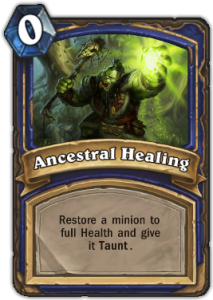 For this I will provide an example. The idea about my latest theme deck was when I saw the card, Ancestral Healing for the shaman. It fully restores a minions health AND gives it Taunt. All for 0 mana. For most people it is considered too situational but in a deck designed around it you might be able to get great value for this card. That was the idea.
So great, you got an idea, next step is making the recipe. This basically means defining the cards that you think are going to make this deck work.
In the case of Ancestral Healing, the requirement to make it work is quite simple. You can use it on an undamaged minion just for the taunt, but ideally you use it on a wounded minion. The sky is the limit for this cards’ healing, so the more wounded the minion is, the better value. Thus it works best on minions with high HP.
The first card that should spring to everyone’s mind is the Injured Blademaster. He arrives on field already wounded meaning you can combo this for a 4/7 taunt as early as turn 3 or 2 with the Coin. Strong enough to slow down just about anything that comes out that early, and almost impossible to deal with cost-effectively.
If I am going to have a lot of wounded minions then the natural transition would be to add even more healing besides Ancestral Healing. It also works here that the shaman’s Hero power can spawn a healing totem. This is something you should take in mind as well when making a theme deck. How can the Hero power assist?
So really now the recipe for my deck was done. Quite a simple one aswell.
| Things That Heal: | Can Be Healed: | ||||
Once you got your recipe done, it is about finding the cards that fits it. Fill your deck up with those and finish it off with some stable cards. And that is really it. The deck is ready to play. You have got a theme deck. Is it good yet? Most likely not.
Intitial Refining
So let this be a warning for you. No themed deck is perfect the first time. In fact I would go as far as to say this applies to all decks that isn’t completely copied from a previous refined deck. But when running a themed deck for the first time, you gotta be ready to lose… ALOT!
Refining a themed deck is as big a part of this as making it. It is a necessity. This part requires some skills of observation as well. It is not enough to figure out that you are losing with the deck, you also have to figure why you are losing. Are you getting too ineffective trades or are you losing board control too quickly? Is there some minion in your deck that just slacks off and is never worth playing. It is about finding those cards who are not paying their rent, and replacing them with cards that can. In this part it is also important to put the recipe away and purely evaluate from what you are seeing from your testing.
You shouldn’t be too concerned about getting crushed with your deck. The difference between a fully refined deck and one in its raw state is actually massive. Even tiny adjustments like getting the manacurve adjusted or boosting the early game slightly can cause massive change in the winrate and consistency of a deck.
So in the case of my restoration shaman deck, it became quite clear what the biggest problem with the deck was as well as which cards were causing it. I had nearly nothing to play in the early game. I was getting stomped. Even one of the few cards that I could play in the early game, the ShieldBearer, didn’t have any attack so it really wasn’t doing anything.
It is one of those things that may seem obvious, but when a deck is made purely from the recipe, then some useless cards are bound to slip in. Other obvious cards that really fit the theme are bound to be missed. It is in this phase that you should indentify those cards if you haven’t already. In my case that missed card was Lightwarden. Potential 7 attack one-cost but she didn’t fit the recipe so I didn’t have her initially.
Evaluate Your Matchups
So your deck is sharpening up and you may start to see some wins. Once this initial refining is done, it is time to evaluate your matchups.
Now every strategy has its strengths and its weaknesses. That is just the nature of a game with variety. The key here is to be able to discover where your decks weaknesses lies. Any further change to your deck should be to try and alleviate that weakness. Here it is also important to have a good eye on the meta game. How popular is your deck’s worst case scenario matcup? It may be that you very rarely see the class that your deck is weak against, or even the type of deck within that specific class. If that is the case, then you may want to ignore that specific matchup and focus on some of the other more commonly seen strategies that gives you trouble.
This part also requires you to have some knowledge about how to beat the various classes. Priests for example have the infamous 4 attack sweetspot. When adjusting towards a single matchup, you ideally want to make as few changes as possible as too big a dedication can compromise your deck against other matchups. It is therefore important to know which cards can make the biggest impact against certain classes.
Final Considerations
Arguably the hardest part of a making a working theme deck is when it has become refined to the point where you can regularly take wins with it. At that point it becomes much harder to pinpoint which cards don’t do quite enough and it also harder to see which cards could do a better job than the ones you are already using.
At this point a lot comes down to getting used to your deck, and knowing the right plays. Knowing the risks of overcommitment or knowing if you should save AOE spells against certain classes. Those are the kinds of improvements you can make even when your deck has reached a stage where you can’t find any obvious improvement.
Finally remember to have fun. If it is too frustrating if your deck keeps losing, then just put it away for a while. You might get some more ideas later.
Hope you have enjoyed this read. Happy Hearthstoning.
SIMILAR ARTICLES








It’s perfect! Love that picture.
Phew that was a big one as well. Took me a week. Fun regardless.
Hope you people enjoy it.
Probably my favourite article, not because I found it interesting, but because that’s what I particularly love doing in card games
Themes can be anything from mechanics you want to utilise(cards with healing, or cards with “deals x dmg” or secrets etc) to stuff that just fit a certain lore(frost mage/resto druid etc).
My favourite MTG theme was of a wizard beating other wizards in battles of wits, and it usually ends up in some kind of permission deck where there’s no victory condition but you end up stealing the opponents victory condition(volition reins/mind control) in order to win, or a blue/red hybrid that manipulates elements(fire/lightning) while using metamagic to disable enemy magic users(counterspells) to win.
My HS implementation of this is a deck I’ve named “Spellstorm” which focuses only on spells and no creatures(appart from antonidas, thalnos, a couple of actioneers and doomsayers for 24-25 total spells) having another kind of permission(you can attack me if I allow you to) which isn’t built to win, but it’s built to provide me with tons of fun when winning.
Finding what fits your fantasy well is, imo, something that makes card games really really fun… Another thing that’s a real nice challenge is trying to optimise a themed deck to win consistently without spoiling the the theme!
Here’s my Spellstorm mage deck in it’s current Iteration(I built it 2 days ago since I didn’t have the cards I wanted till then and it’s still in a very fluid state with cards being added and removed daily, but this is what it looks like right now) :
https://www.hearthhead.com/deck=12087
I’m having a blast with it, and while my win rate is kinda low, the games that I win i’m having so much fun it easily counterbalances the lost ones.
Yesterday I was fighting a warrior, he had a full board(5 creatures) and 22 hp, I had 1 auctioneer on the board, 1 hp and 1 frostbolt 1 bloodmage thalnos in my hand, and he skipped the auctioneer to zerg me down and brought me to 1 hp. I thought screw it i’ll go for it and put thalnos down and frostbolt his face. auctioneer draws icelance, i throw it on him, auctioneer draws second frostbolt which I shoot him with, leading to a second icelance for a total of 18 dmg which went to 22 with auctioneer’s 4.
I’d be curious to see what other people’s themed decks are like
[…] Статията е преведена. оригинал - https://ihearthu.com/screw-the-meta-a-guide-for-themed-decks/ […]