








My Cat Says Hearthstone is Pay to Win
Author: Andrew ‘The Water Boiler’ Klawitter
The Pay to Win perception is exemplified by losing, out of no where, to flashy Legendary cards such as Leeroy Jenkins and Alexstrasza. “Burst Decks” as I like to call them. The smaller, less potent offspring of the OTK (one turn kill) decks.
The Molten Giant-Leeroy Dichotomy
This iconic character from the WoW interwebs meme is one of the most powerful finishers in the game of Hearthstone. But how did we get to this point, where many of the top decks use Leeroy Jenkins as a primary finisher?
Various burst damage combinations most often experienced in the hearthstone ranked scene are as follows (with links to those decks, should you care to try them out):
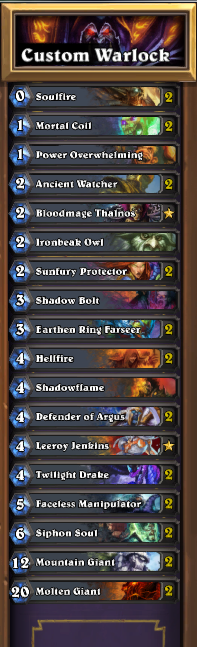
- Handlock (Warlock)’s 10 crystal cost, 3 card, combo of Leeroy Jenkins, Power Overwhelming, Faceless Manipulator for 20 burst damage.
- Miracle Rogue’s 7 crystal cost, 3 card, combo of Leeroy, Shadowstep, Cold Blood for 16 burst damage.
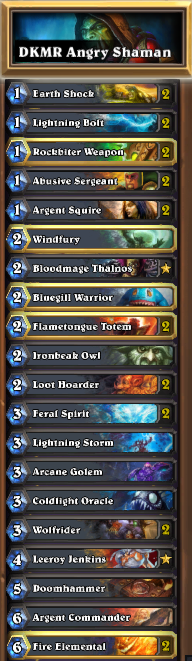
- Shaman decks have a 3 card, 7 crystal cost burst in Leeroy, Windfury, Rockbiter Weapon for a total of 18 damage.
- Even Mid-range Hunters using Leeroy, Unleash the Hounds, and possibly a Kill Command, can get a bit of burst.
The potency of these decks is granted by effectively negating Leeroy’s downside if he’s used as the final points of damage in a game, to push through a victory. [** I would like to thank Team DKMR for their metagame rundown each week, as the source of many of these quick decklist snapshots. **]
Similarly, Control Warrior prefers to use Grommash Hellscream over Leeroy Jenkins. This warrior-specific Legendary minion has a stronger board presence, if slightly lower initial damage. Grommash + Cruel Taskmaster + Inner Rage for a 10 crystal cost, 3 card combo, to push 14 damage. (or Grommash Hellscream + Whirlwind + Execute, for a weaker 10 damage push, while also removing a pesky taunt that is in Grommashs way)
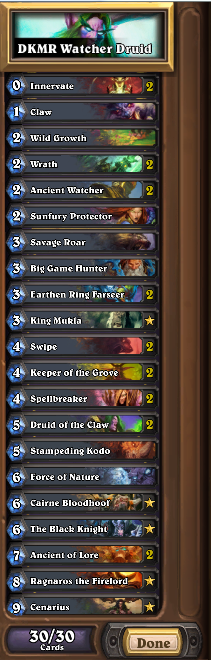
Alternatively, Druid burst damage is generally in the form of Force of Nature + Savage Roar, a 2 card, 9 crystal cost combo, for a bare minimum of 14 damage points. Which gets even better with multiple minions already on the board.
The reason many ranked play decks evolved to emphasize burst damage win conditions is because of the existence of an equally powerful last-ditch-effort defensive minion, with a combo of his own.
Taunting a Giant
At even 15 life, a Warlock can Life Tap, followed by two, 3 crystal cost, Molten Giants further buffed by a Sunfury Protector to generate two 8/8 taunts for an late-game total cost of 10 crystals.
So unless you have an answer for a few 8/8 taunts, at a moment’s notice, (or a way to deal damage past the Taunts, such as in Freeze Mage’s 3 card, 10 crystal, 15 damage spell punisher of Double Fireball, Frostbolt) you have to rely on a burst of damage to end the game, before your opponent is put into that <14 life range.
This can be especially frustrating for beginning players, when they feel they are safely sitting at 16-24 life, and the thoughts of “how can my opponent possibly kill me”, quickly become “wow, the opponent is so lucky”.
So, how much health do you need to stay ahead of these Burst damage decks? Unfortunately, the answer is not that simple. There is another Legend that provides an assist to Leeroy’s big finish (or other bust damage shenanigans), Alexstrasza. Setting the stage on turn 9 for a turn 10 burst kill, leaving you exceedingly vulnerable at the precarious life total of 15, no matter what your life total was before.
Armor, Secrets, and Taunt
If having a reasonable life-total isnt a solution, then what possible responses are there to the burst deck type? There are a few at our disposal, such as adding Armor, casting Secrets, or hiding behind Taunt minions.
Armor allows the building up of additional lifepoints, while avoiding an Alexstrasza reset. Control Warriors take full advantage of this mechanic, using all the armor building cards, and spending a substantial portion of the early game just building up their hand, and ticking up their armor. The biggest downside to this mechanic, is limited availability. Only three classes have armor available: the Druid, Mage, or Warrior.
Secrets can also provide a similar protection, and are limited to three classes as well: the Paladin, Hunter, or Mage. Most notable is the Mage Invulnerability secret, Ice Block, which will give you an extra turn to finish 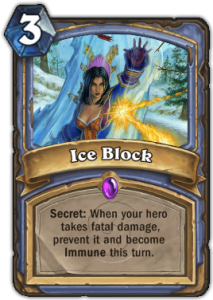 your opponent, when you would otherwise have been defeated. Unfortunately, few other secrets can effectively mess with your opponent’s game plan. While they might seem useful in the abstract, a well versed opponent can play around them.
As an example, the Paladin Secret, Noble Sacrifice, can redirect an attack to a new 2/1 minion. Similarly, the Hunter Secret, Misdirection, will redirect a direct attack to another character on the board. The difficulty with playing these secrets, is their effect is mitigated when your opponent has even a single minion on the board. They will simply attack with the previously played minion, triggering your secret, and thus allowing their burst damage combo to get though.
Everyone else, (Rogue, Shaman, Warlock, or Priest), are stuck with relying on Taunts; Unless your entire deck is Taunt minions, its generally very difficult to continually have a taunt minion on the board, to prevent bursts. Even then, a single taunt minion can conveniently just get Sapped away! To this end, cards like Feral Spirits can provide excellent protection, because it creates two taunt minions with a single card.
This is also why the Sunfury Protector and Defender of Argus provide such utility in multiple decklists. Using a few large body, cheap cost minions, and providing them with a taunt buff, you can generate a substantial roadblock for your opponent to get around.
This leads us full circle, as it becomes quite obvious the best minions to combine with these taunt-givers are the 8/8 Giants, which are the exact cards that burst damage decks have been built to play around!
Where does that leave us?
Well, not in a very good spot. As players who want to avoid “Pay to Win”; (You thought I forgot about you, didn’t you.) We’re stuck looking at multiple massive giants, or explosive legendaries. I guess there is a reason many newer players end up with various Zoo-like decks.
SIMILAR ARTICLES









MY DOG SAYS YOU ARE BUTTHURT AND CANT HANDLE A COUPLE OF GIANTS
Firstly i disagree about Hearthstone being “pay2win” . I have not spent any real money on this game nor do intend to and I do quite well. I got to legend in season 1 with my druid deck that i spent weeks saving up the dust for and doing arena run after arena run. When I achieved legend i thought it was really cool. I also got legend last season using a different version of that same druid deck and Zoo.
I saved a lot of dust and disenchanted anything I didn’t need to make that druid deck i wanted because druid is my favorite class so i didn’t mind grinding it out for a while to get the cards I needed. I was lucky to open one of the legionaries i needed for my deck after countless arena runs. Most of which went below 5-3. I got Thalnos in a pack and crafted Rag, Cenarius, Cairne, The black Knight and all of the other epics you need for a druid deck.
There are also countless other stories of how other people have gotten to legend(and even performed well while in legend to get a really good placing) without paying for packs. Many popular streamers have done F2P runs to get to legend to help emphasize that this game is not pay2win.
Leeroy is a tricky subject because it is played in a lot of decks but it is a really good card so its not unusual to see it in the “top tier” decks. I’m kind of on the fence about whether it is good for the game or not but i am leaning towards good as it is such an iconic card.
Leeroy was super prevalent in Zoo and Hunter in previous seasons but decks are always updating and finding better cards to optimize the strategy to win
Handlock is an expensive deck to craft compared to other decks. I would put it in the same price category as Control Warrior or a Control Druid. It is being played as a good counter to the most popular deck atm - Miracle Rouge. While Handlock has OK-good match-ups vs control style decks it is pretty weak to aggro.
if you play the match-up enough times you will understand what is good and what is bad vs the giants. So many decks this season are running 1-2 Big game hunter and or The black knight as an instant +1 against handlock. People are changing their decks and adapting to the metagame and that’s really good.
Blizzard give people the option to not necessarily pay for their victories but rather fast forward the progress of gettin the deck faster. Just because you can pay to make an expensive and successful deck you are still going to have to learn how to play the deck well and learn the match-ups if you want to do good.
First, I must apologize for my article being a little too “tongue in cheek” for you, that it caused a misunderstanding.
The title was meant in jest. I thought the image of the cat, with the “claw and bite” caption would have adequately implied the kidding around.
In all seriousness, I was pointing out that the perception of “pay to win” is a significant one for many newer players, and the rational behind why it feels this way. I was not condoning the game as pay to win, just pointing out how most of the decks that see top level ranked play, and especially in tournaments, will be those with explosive legendaries or multiples of epic giants.
As an experienced player, with access to all the cards available, I took it upon myself to analyze the “burst deck” evolution, reading up on articles and deck designs from October 2013-Present. I then formulated this article as an explanation of the current game-state and how Leeroy Jenkins and the Molten Giant are two opposite sides of the same coin. The extremes of two very focused strategies, one offensive, and one defensive.
With the current card pool and deck construction, we, as players, have evolved our decks to the point where we tend to favor “burst decks” as our primary win condition in all the top decks. (just look at any recent tournament decks list and you will see) - This style of deck can be very discouraging for players new to hearthstone to have to face.
While there are many solutions to a single 8/8 giant, the real question you need to answer is how do you stop Burst Damage? Are you just going to cross your fingers and hope for an opponent not to draw their combo? I tried to point out that the cards that can create multiple taunt minions in a single turn are the strongest means to avoid getting hit by burst damage.
Lastly, Yes, it is indeed possible to grind your way to “Legend Rank” without paying any real world money. But if you are using Legendary or Epic cards, you are still investing a significant amount of time in the game, which is paying for a deck, you just pay with time spent in game, instead of in dollars. Which is why I ended the article by pointing out that new-to-hearthstone ‘free to play’ competitive players gravitate towards the Zoo-style decks, because they are cheaper to build, due to being less dust intensive.
I hope this clears some misinterpretations up.
I have to agree with Touhou that Hearthstone is most definately NOT pay2win. It is certainly pay2win faster, but with a reasonable amount of play time you can build a good deck and be successful with little to no legendaries. I made rank 8 with a shaman with no legendaries or epics in my first season of playing, and if I had known then what I know now then I most certainly would have done better.
I have not felt at any point that I needed to spend money to win at this game, I just adapted to handle the decks that were in the meta. Having trouble with giants? I hear big game hunter is good. Leeroy giving you trouble? there are taunts for that. Diving shield wrecking your field? Blood Knight. It’s all about working with what you have and conserving your answers so that you are ready to counter those cards in an efficient manner.
A cute caption under an unrelated image won’t offset the lack of integrity in this article. It reads as if your premise is that because burst exists in the game, it must be pay to win. That’s not even a bad argument as its not an argument at all.
In order to be pay to win, there must be something in the game that cannot be had without money AND it must significantly increase one’s chance to win. Nothing in Hearthstone fits either of these criteria, let alone both.
This article has nothing to do with the topic of pay to win or cats. Your title was deceptive.
Wow such defensive bitches posting in this forum. It was a great, accurate article. Just because you point out that you can grind out a decent deck and make a decent rank is not evidence for this game not being p2w. Stop being unrealistic, defensive bitches.
I really enjoyed reading that article as it gives some thought processes behind a major problem Blizzard will have to face in the future.
As the game progresses with new cards (Naxxramas hopefully to appear soon…) and the number of veteran players with a vast card pool will increase, newer players may find it quite frustrating to invest that much time just to catch up especially after the first couple of addons released.
So for rookies to stick to the game I think Blizzard should introduce some sort boost mechanics (free and payable), for example Extra-Gold-Weekends or Free-Booster-After-25-Wins-Weekends. Don’t nail me on those suggestions but I think you get the idea.
They were doing the same with Diablo 3 and it definitely paid off. A lot of players I know returned to playing the game after the drop chance of legendaries was increased (myself included). With Hearthstone being a relatively fast paced game the amount of time the majority of players are willing to sacrifice is lower in the first place.
The fact that you can get to legendary with a deck that costs less than a single legendary to me means the game is not p2w. No f2p game is going to give you everything up front as they need to make money, and I believe getting things faster by spending a little money is a reasonable way to do that. The fact that you CAN play this game and make a decent rank without grinding for months is a perfectly valid argument for it not being p2w.
I’m not saying the article is bad because there is some good information in it, but the fact that there is crazy burst damage that can be done doesn’t make the game p2w, it is actually a problem all on it’s own. So before posting about “defensive bitches”, maybe you should try and understand where they are coming from.
I agree with kendricko. the bigger the pool of cards become as the game ages the harder it will be for new players. I think special weekends that help players progress would be a good thing. I also think they should introduce “intro Decks” or even some form of “event Deck” like in MTG as this would help beginners and older players alike.