

Kisstafer’s Corner - Hunter is Back
Author: Kisstafer - Twitter | Tumblr | Youtube
Since the popular aggro deck archetype with dark iron dwarf and shattered sun cleric had been nerfed in the last series of patches, it caused the metagame to shift to more greedy, late-game control decks. Kungen seized the opportunity to cheese out wins against these greedy players by bringing the newly buffed hunter back into the metagame.
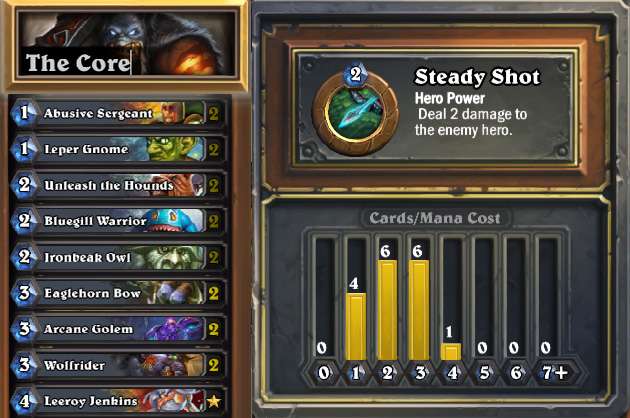
Kungen brought hunter back in force pretty soon after the second test season started by getting to Legend with his newly popularized deck. Kungens deck is an adaptation of ArkCruiser’s pre-patch hunter that uses all of the charge minions, including Leeroy Jenkins, and revolves around doing as much damage to the opponents face as fast as possible.
Old Decks
[su_lightbox type=”image” src=”https://i.imgur.com/4mAc7bM.png”][su_button]ArkCruisers Hunter Deck [/su_button][/su_lightbox] | [su_lightbox type=”image” src=”https://imgur.com/knMQQYT.png”][su_button]Kungens hunter deck[/su_button][/su_lightbox]
With the addition of the extremely potent Unleash the Hounds and Timberwolf combo, the deck has become even more deadly with the recent patches. Seeing the raw power of this deck in its relatively unrefined state, top Legend ranked players began work on refining the deck even further. In the recent “Chat Lethal Invitational” featuring some of NA’s best players, kitkatz won the tournament while toting a hunter as one of his three decks. His decklist was published on the Chat Lethal website and looks like this:
New Decks
[su_lightbox type=”image” src=”https://imgur.com/ILhaxEd.png”][su_button]Kitkatz Hunter Deck[/su_button][/su_lightbox]
The primary difference between it and earlier versions is that kitkatz’ version makes use of Starving Buzzard and Hunters Mark, cards which push the limit of how strong the new Unleash the Hounds can be. In the following gameplay video I will show you the correct way to play the deck; I will be using kitkatz version except that I prefer to use Animal Companion over Arcane Shot, a stylistic choice.
 Card Choice Analysis:
In this section I will go over why cards that aren’t part of the core are added, and how they help achieve the deck’s goal.
Hunter’s Mark: This helps get big taunts out of the way, or kill minions that are threatening to kill you first.
Arcane Shot: This card acts as a 1 mana version of the passive ability, extra damage never hurts with this deck. It also combos with Hunters Mark so that you don’t have to throw a minion at their creatures.
Tracking: This is really helpful when you’re trying to dig for your Unleash the Hounds combo, or if you really need that last Leeroy Jenkins to finish them off.
Timberwolf: This card goes incredibly well with Unleash the Hounds, able to deal incredible amounts of damage for only 3 mana.
Starving Buzzard: When you have Unleash the Hounds spawning upwards of 3 minions, the Starving Buzzard becomes an insane draw engine. The mana curve on this deck is very low so it can be easy to run low on cards, this keeps your hand full.
Explosive Trap: This card is good at making sure they don’t have early minions down that can retaliate against you, it does 2 more to their face, and it fuels your Eaglehorn Bow.
Misdirection: Misdirection’s use is threefold, a) it keeps your HP high, and b) it reduces your opponents HP and c) it fuels Eaglehorn Bow
Kill Command: With so many beasts in the deck, 3 mana for 5 damage is a shoe-in.
Matchups
Hunter has a strong matchup against decks that don’t contain a lot of healing, small removal, or taunts. They can have a little of each, but too much makes the deck unable to finish them off. This deck has the potential to do upwards of 50 points of damage over the course of a game assuming minions don’t swing twice. However; the reality is that you will run out of cards to play before you run out of damage unless you get off a godlike Unleash the Hounds + Starving Buzzard combo. If the opponent can heal for absurd amounts, or block enough of your damage through taunts, it is likely that you will run out of cards or die before you can deal enough damage to kill them. Everyone else is live bait.
Rule of thumb: If your opponents cards are more efficient than yours or he has more of them, prioritize going to his face; If they are equally or less efficient, it’s OK or even suggested to trade. Since this deck’s mana curve caps at about 3 with only Leeroy Jenkins above that number, it would be pretty hard to find a deck that has less per-card efficiency. For that reason, most of the time you will want to hit them in the face.
vs Early game decks:
Against early game decks that function sort of like yours does, it actually becomes OK to trade minions if it means that you prevent more damage than you lose out on. You basically want to look for situations where you can trade your Leper Gnomes for his Faerie Dragons and get a board advantage. If no clearly advantageous trade presents itself, just ignore his creatures and continue going to his face. These weenie vs weenie matchups are all about who can deal the most damage the fastest. If for whatever reason you can not deal damage as fast as your opponent can, you will be forced to trade your minions in order to protect your life. This is not a situation you want to be in because it means his creatures get to hit your life but yours can’t hit his, in other words you will slowly bleed HP until you die. This is why it’s important to look for favorable trades in this matchup - so you can prevent his most damaging minions while simultaneously enabling your own. Usually whoever gets the fastest start will win in this matchup.
vs Mid + Late game decks:
Against decks like Druid, Warrior, and Shaman that have a higher per-card efficiency (their cards can take out 2+ of yours, like when a Chillwind Yeti kills two Bluegill Warriors) you really have to emphasize going to their face. The reason for this is you have to end the game before you run out of cards. If he keeps killing two cards with each of his own, you will eventually run out of cards to play with, so you have to bring his health to 0 before his efficiency pays off. Your goal is to kill him while his hand is full of cards that he doesn’t have enough mana to play yet. Many decks are sitting ducks to Hunter because of how slow of a start they get, and their inability to retaliate quick enough. On the flip side, there are decks such as common Druid templates that have enough heals and taunts to survive the onslaught long enough for their superior efficiency to kick in.
One of the strengths of playing an aggro deck like hunter is that because all of the cards have such low costs, it’s hard to get a truly poor opening hand. This doesn’t mean you will get a god-hand every game, but it means that a lot of the time you can simply steal games against Mid-Late game decks when your opponent has a bad draw.
[youtube url= https://www.youtube.com/watch?v=2ZF9vGS7Eyo]
This Hunter deck is very strange because it ignores the paradigm of making favorable minion trades to garner advantages, and instead it treats all of it’s minions as glorified damage spells. For example, Wolfrider is a 3 damage spell that happens to leave a 3-1 minion behind. When playing this deck you want to send all of your damage to their face unless their minion is threatening your life or in taunt mode.
SIMILAR ARTICLES