








Improving Your Game: 10 Tips on How to Become Better at Hearthstone
Author - Puffin on: Twitter | TwitchTV - Team: Clarity Gaming | Twitter
“I’m just not getting any better”, “The luck’s just not with me today”, “This game is all RNG”. These and other similar phrases are often uttered players or going through their mind after a tough loss, and quite possibly even by yourself. Luck definitely plays a part in Hearthstone or any card game of its type, but you can try to turn the luck into your favor by taking steps to improve your game and give yourself the best chances to win with each decision. Below I’ve compiled a list of 10 tips that have made me a more consistent and better player and will help you play better as well.
-
Know your enemy
 You may enjoy a particular class or classes, and despise others, but in order to truly improve your game and understand all match-ups, you’ll have to bite the bullet and play every class, at least enough to understand all of their match-ups. Good ways of doing this are to first, try all of the classes in Casual play or with a friend. Additionally, you can open yourself up to more classes via the Arena by playing classes you normally wouldn’t. Have a quest you haven’t completed? Try an arena with that class to kill two birds with one stone or play some games in Casual. Unsure how to build a deck with a class you don’t know? Check out decklists from IHEARTHU or popular constructed streamers. It’s important to know all of the classes and how they play each matchup so you know what cards and situations to play around. Of course, it will take a lot of games and experience to fully master and understand how each class and deck plays against others, but just familiarizing yourself with every class will put you a step ahead.
-
Learn from your mistakes
Instead of placing blame on outstanding factors for your loss (bad luck, distractions, ghosting if you stream) try to think objectively about the previous game and pinpoint any possible mistakes you may have made or any plays you could have done differently. The only way to improve your game is to identify the things you can improve on. Did you overextend on the board by playing a 4th minion that your opponent was able to punish? Did you not calculate the possible damage your opponent could do before deciding to attack their face instead of clearing? Did you take a risky play when a safer option was available? Did you make too safe of a play when the risky play was the only way for you to win? Trying to be self-critical is extremely difficult, but is the only way to truly determine if your play is optimal and it was really due to bad luck, or if there were better decisions you could have made to affect the outcome of the game.
-
Play with a friend or coach
Since being self-critical can be difficult, something that can be extremely helpful is playing with other people viewing on your side to offer advice or a different perspective. Two heads are better than one, right? As a streamer, it’s commonplace for chat to offer play suggestions and even point out that I’ve missed lethal, and occasionally they’re correct. Being able to look back on these errors to see how they happened will help you be more aware of them next time. A more effective way of doing this is to have a friend or group of friends talk you through possible plays or watch from your perspective and comment on possible moves either during or after a game. If they’re in the same room as you, that’s even better, but it’s fairly easy to set up a Skype call or Google Hangout where you can share your screen with someone and let them see your games to provide advice. Ideally, they’ll be someone whose level of play you respect and are at a similar level as your skill level or above. Often there may be complex plays that you may not be aware of that they see that you would have missed on your own, and it’s helpful to be able to talk through these decisions with another person.
-
Study top level players
Similar to playing with friends is to try to imagine you are in the spot of a top level player and try to predict and anticipate their plays before they make them. This is helpful if you are watching them live on a stream as you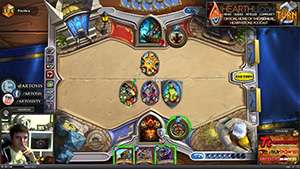 can ask them questions about why they made a particular play instead of another and hopefully they can explain their thought process. If your questions or comments are constructive, streamers are usually happy to help explain to viewers why they made a decision the way they did. Also watching with the mindset of trying to think of the play before the person you are watching makes the play will make your analysis of the game quicker and allow you to think more critically about game states and situations. Another good resource to do this is with showmatches and casted games such as King of the Hill, ESGN Fight Nights, Deck Wars and others that are sure to crop up.
-
Keep track of cards played
This may seem like a lot of work, but if you really care about a particular match, say it’s a tournament match or your legendary match, it’s very helpful to keep track of all of the cards you’ve played and those your opponent have played. Has your opponent used the second AOE (area-of-effect) spell that you’re playing around? How many removal spells have they used? You may think it’s easy for you to remember all of the cards you’ve played, but why take the chance that you misremembered playing something? Knowing how many outs you have left with the cards remaining in your deck can affect how you play a situation out. A simple way of tracking this is to open up two blank notepads on your computer and just noting all of the cards played by your and your opponent (or you can use the old pen and paper method). It may seem trivial, but saving your brain cells thinking about the play at hand instead of trying to remember if they played that second hex already could really put your mind at ease and let you focus more on the play.
If tracking all of the cards seems like too much of a chore, you can start by just tracking coin usage. A simple trick is to take advantage of the permanent destructibles (clickies) around each of the game boards to activate when coin has been used, so you can use it as a reference instead of trying to remember or figure it out.
-
Pay attention to the game
It may seem obvious, but it’s important to pay attention to your opponent during their turn as there are certain tells you can pick up throughout the game since you can see what your opponent is mousing over and selecting. It starts with the mulligan, you can see how many cards your opponent mulligans which can give you a sense of how strong their initial hand is. If they don’t mulligan any cards, they’re likely to be very happy with their starting hand (and also more likely to be playing an aggressive deck since they’ll have more reliable early draws). Have they not played the first card in their hand for the first 4 turns? It’s likely to be a removal spell or AOE spell of some sort, some type of answer card that they felt was important to keep in their opener and are waiting for the perfect time to play. You should try to bait that spell out first before playing out something stronger. Also, discarded cards do not show up in the card history so if your opponent plays Soulfire or a Doomguard, it’s important to be watching to see which cards they discarded so you have an idea what’s left in their deck and what types of cards they are playing. This also is important if they burn any cards (by having too many cards in hand and drawing).
Another small tip is that you should avoid running unmatched gold cards in a set. If you have both golds, that’s fine, but running one of each can tip off our opponent that you have 2 copies of a certain card if they play against your deck more than once. Little details like this can give you a slight edge, and in a game like Hearthstone, every little advantage adds up to more victories.
-
Take your time
In Constructed and Arena play, you have 90 seconds to take your turn. Take advantage of this by thinking through all of your options prior to making any moves. By no means should you intentionally slow-play obvious plays, but take a few extra seconds to ensure that you are ready to make a play and have thought through all of your options before reaching for any of your cards. It also helps to play your cards slowly to avoid the hand bug and dancing minions. This tends to result from animations of cards not completing before another cards is played, so play each card one at a time and take each action one at a time ensuring you allow ample time for the animations from each card and action to play out first. Also, be careful about how you mouse over your cards and if you change your mind on decisions and pull cards back. Your opponent can see how your mouse hovers over cards and if you attempt to play a card on something and change your mind or aren’t able to play it. It can reveal things about your hand to an observant opponent. If you need to read something on card, feel free to do so but make sure you hover over other cards as well so as not to make it too obvious what a card could be. Think about how you want your entire turn to play out before you begin to start playing cards. If your turn is dependent on random effects such as card draw or juggler pings, then play cards in the order you need to before deciding your next action. In general, it’s a good idea to draw cards first (this includes drawing a totem if you are a Shaman: Totem First!) to see what options you have available before making your next play.
-
Keep track of your stats
 If you are serious about improving your game, tracking stats can help you identify key matchups or classes that you need to work on to shore up your game. There are some great resources available to track both your arena and constructed stats. I use a great piece of software called HearthTracker to track my game stats. It’s fairly easy to setup, runs in the background, and automatically tracks your games including your class and your opponents, whether or not you went first or second, and the length of the game. It tracks both arena and constructed games and you can edit entries of they are incorrect or if you forgot to turn the program on and want to add in games retroactively. It can also track a specific deck if you want to try a new deck and see how well it performs. I use a website called Arena Mastery to track my arena stats. It has a nice interface with a good collection of stats such as the type of rewards you received from your arena runs, win rates and averages, and some nifty stats from all users of the site. There are many cool stat-tracking tools available out there, but these are the two I currently use most.
-
Use your resources
As mentioned in a few of the points above, there are loads of valuable resources available to you to improve your game. Take advantage of them! If you’re reading this, you’re already ahead of the game. Seeking out articles and guides on community websites, being involved in the community forums and other outlets, interacting with other community members on stream channels and directly with streamers, all will ultimately improve your game, but most importantly, make your involvement and enjoyment of hearthstone more fun.
-
Have fun
The most important piece of advance is simply to have fun. Hearthstone is a great game, and people can take it pretty seriously. In fact, to truly improve and be competitive at the game you do have to take it somewhat seriously. But the game at its heart should still be fun for you or why are you playing it? If you aren’t enjoying the game, you won’t be playing your best. If you are tilting after some bad luck or run of bad games, go take a break, or play something less stressful like a casual game with your fun troll deck, or play an arena if you’ve been grinding the ladder and hit a rough spot. If you’re getting bored with a deck that’s been working well for you, try something new. Experiment with different strategies or try to come up with a new deck that could break the meta, or just something that will be fun for you to play with. Want to make Millhouse Manastorm or Lorewalker Cho work? Do it! Alarm-o-bot your way to Legend? Have at it and have a blast doing it! One of the most fun times I’ve had in Hearthstone was playing with an all Dragons Alarm-o-bot deck where only Dragons and Alarm-o-bot got played. Even when Ysera summoned Laughing Sister, we couldn’t play it, but that was the fun of it, and it made for some of my most memorable games and one of the funnest nights of Hearthstone we had in a long time. Make your own memories and make your or stories, and above all else, have some damn fun!
SIMILAR ARTICLES







Great article. Number 2 really sticks out to me because it is tough to acknowledge the fact that a loss may be due to my own mistakes. It is much easier to blame a loss on rng, bad luck, or bad draws, but doing so can result in preventing yourself from learning a great deal. I think it goes hand in hand with number 10 as well, because I find that when I am blaming losses on such things and not analyzing it I am not really having fun and am taking the game a little bit too seriously. At the end of the day, this is a game and the main goal should be to have fun.
[…] findest du die 10 Tipps in der Kurzübersicht, die komplette, ausführliche Version kannst du bei iHearthU […]
Hey, you might want to look at Hearthstone Tracker as well for tracking. It has good accuracy, can capture full-screen and has lot’s of useful statistics. Pretty heavy in development too. https://hearthstonetracker.com/
If there’s anything you’d like to see added, send me a pm
Great article puffin
Nice for newbies ;] gj
[…] SE DIVIRTAA peça mais importante é se divertir. Hearthstone é um jogo incrível, e as pessoas podem levá-lo muito a sério. Mas um jogo como este precisa ser divertido. Senão, porque você o está jogando? Se você não está gostando do jogo, você não jogará o seu melhor. Se você está ficando de cabelo em pé com a má sorte ou com jogos ruins, então saia um pouco, tome um ar, jogue algo menos estressante com um jogo com um deck troll(deck temático, ou aquele deck que você fez na louca), ou jogue uma arena caso você está em um rank que não consegue passar. Experimente estratégias diferentes, ou tente um novo deck que pode quebrar o metagame(conjunto de dekcs que estão dominando o jogo). Quer testar o Alarmobô com uma carta pesada? Teste! Quer ver se o Frango Nervoso vai funcionar num deck de Sacerdote? Não tenha medo, tente! Muitos dos melhores jogos que você vai ter no Hearthstone serão os jogos em que você menos estará preocupados, estes serão os seus jogos mais divertidos!Então galera, antes de tudo: VAMOS NOS DIVERTIR!!Texto original escrito por: PuffinTraduzido e adaptado por: FeidhlimArtigo retirado do site: https://ihearthu.com/improving-your-game-10-tips-on-how-to-become-better-at-hearthstone/ […]