








Hearthstone 101: Beginner Handbook
(You can also comment at the bottom of this post, it will automatically synchronize with the forum thread, and vise versa)
MULTIPLE AUTHORS:
TheWaterBoiler
Rafajafar
Index:
- What is Hearthstone?
- Hearthstone as a CCG
- What’s the difference between a CCG and a TCG?
- What makes Hearthstone so unique?
- Play Basics
- Gameplay objective
- Mana and Draw
- Turns
- Heroes and Hero Powers
- Cards
- Types of cards
- Minions
- Beast
- Dragon
- Demon
- Murloc
- Pirate
- Spells
- Secret
- Weapon
- Minions
- Card attributes
- Drawing cards
- Types of cards
- Attributes
- Battlecry
- Charge
- Deathrattle
- Enrage
- Spell Damage
- Stealth
- Taunt
- Wind fury
- Effects
- Divine Shield
- Freeze
- Immune
- Silence
- Class Specifics
- Choose One - Druid
- Combo - Rogue
- Counter - Mage
- Overload - Shaman
- Earning cards
- Pay for Them
- Gold
- Rewards
- Daily Quests
- Crafting
- Now what?
- Practice mode
- Casual play
- Ranked play
- Arena
- Conclusion


Well hello there! So, you’re interested in Hearthstone and want to learn more? Pull up a chair by the hearth and listen!
Hearthstone is a “Collectable Card Game” (CCG) that puts players head-to-head in battles of both skill and luck. Currently there are 514 cards available to the player to collect and use in battles which can last anywhere from 5 to 30 minutes. The average game is between 10 and 15 minutes, though. Hearthstone is a casual game whose theme is based off of the lore of World of Warcraft. It’s mind-bending, heart-racing, thought-provoking, and fun!
You may have heard of the World of Warcraft “Trading Card Game” (TCG) that’s been out since 2005. This is not the same game but it IS still in the spirit of World of Warcraft and card games in general. What separates the CCG from the TCG, you may ask? Well, in Hearthstone you cannot trade your cards! You can collect them but you cannot exchange them with other players. While this may sound inferior, there is an excellent crafting system built in to compensate.
What’s more important is that Hearthstone is able to do things that would be near impossible in a TCG. Since it’s only using cards as a unit of “idea” of sorts and the server tracks all statistics, long gone are the days of needing to keep track of health, armor, or what order cards should be executed. The Hearthstone client and server takes care of every bit of that oft-tedious logic and enables a more complex gameplay than one could have seen with a physical trading card.
What sets Hearthstone apart from other CCGs? First off, community. Blizzard has a long history of gamers from all walks who have convened together to use their Battle.net system since 1995. These gamers have shown themselves to be quite faithful and are regular consumers of Blizzard products. In other words, Hearthstone has player diversity. In addition, Hearthstone is a very well-balanced game. With its crafting system, if a new overpowered combination is found that unbalances the meta game, Blizzard can correct this without banning cards entirely. This is because the player can be refunded these cards for their full value if they do not like the change. Last, and most important, Hearthstone has quickly risen in the eyes of the E-Sports (electronic sports) community. This means you will see more and more Hearthstone players who compete at a professional level. This is something you will not see as much from other CCGs currently released.
Play Basics
Now you know more about what makes Hearthstone so great, so it’s time to learn to play. Most TCGs have play phases which allow the dynamics be more manageable. Hearthstone does not have such a system. Instead anything can be executed in any order during a turn. This is part of what makes Hearthstone such a fantastically unique game. If you want to do something, you normally can, and if you cannot, the game will tell you. This lowers the learning curve quite a bit. Nonetheless, there are still some dynamics you need to understand.
Gameplay Objective
As with most card games of this nature, the goal is to reduce your opponent’s health to zero. Each hero begins with 30 health. Through some combination of spells, effects, and minion damage your goal is to bring that health down to zero. Of course, your opponent won’t make that easy on you so you must find a way past his defenses to bring your foe to his knees.
Mana and Draw
 Each player begins with 1 mana crystal to use for paying the cost of cards. Each player alternates taking turns, and with each turn a player gains 1 additional mana crystal for using cards. This effect will continue until a players reaches the maximum of 10 mana. At the beginning of each turn a player will be forced to draw a card as well, keeping your hand reinforced and healthy!
Turns
 At the beginning of the game, a coin is flipped to determine which hero goes first. In the event that your hero goes first you are given three cards and asked if you wish to discard any or all of them. This is called a “mulligan”. If you choose to discard any of these cards, you will be given a new card randomly from your deck, excluding the card that you just replaced. If you happen to draw the same card as the one you discarded it was because you had multiple copies of that card in your deck.
This does give an advantage to the player that goes first, though. In Hearthstone, to compensate for this first-turn advantage, the person who draws to go second picks an extra card from their deck (for a total of 4) and is allowed to discard any or all of them. In addition, the second player is given a spell called “The Coin”. This card allows you to gain an extra mana crystal extra for one turn. This means if you have a 4 mana card you wish to play on the turn when you have 3 mana, you can cast The Coin and get the extra crystal for 4 mana for that turn only. Blizzard ran the math on this and saw that in the lower ranks, first-turn advantage was only 4.4% with this system, and in higher ranks that percentage drops to 0.7%. This is pretty good for a card game, no?
Each player will alternate turns, with these lasting until they declare the end of their turn or their turn timer runs out. This goes on until one player is reduced to zero health. In the event that any player runs out of cards, they take what is known as “fatigue damage”. Every time a player is asked to draw a card and cannot because their deck is empty, they take an increasing amount of fatigue damage, starting at 1 damage. In the event that both players happen to reach 20 fatigue damage, both players die and the game is declared a draw.
Heroes and Hero Powers
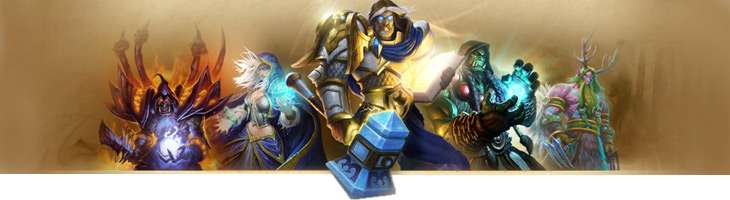
In order to play, you must construct a deck that is based around a particular hero. A hero is a class of character that has special cards and a special power, called a “hero power”, which makes that hero unique. These special cards appear in your card book under the hero they are assigned to and can only be used in decks of that hero type. The hero powers can only be used by this hero, as well, and costs 2 mana. Below is a list of heroes and their hero powers:
- Druid — Shapeshift — Gives you hero 1 armor and also 1 attack. The attack lasts for this turn only.
- Hunter — Steady Shot — Allows your hero to strike the opponent hero for 2 damage directly.
- Mage — Fireblast — Allows your hero to strike any minion or hero for 1 damage directly.
- Paladin — Reinforce — Summons a 1 / 1 Silver Hand Recruit.
- Priest — Lesser Heal — Heal target for 2 damage.
- Rogue — Dagger Mastery — Equip a 1 / 2 weapon.
- Shaman — Totemic Call — Summon a random totem. Healing Totem, Stoneclaw Totem, Searing Totem or Wrath of Air Totem. Two of the same totem may not be in play at the same time.
- Warlock — Life Tap — Your hero loses 2 health and you draw a card.
- Warrior — Armor Up! — Gain 2 armor.
Cards
 If it wasn’t clear, Hearthstone is a game about cards. You build a deck from the cards you have in your book and use that deck to attack your opponent. It’s important to know exactly what can go on a card to understand the fundamental dynamics of the game.
Types of Cards
There are many types of cards in Hearthstone. Below is a simple explanation of what cards you will encounter in this game:
Minions
A minion card is placed on the battlefield and available for play. When you drop a minion, it is not immediately playable (unless it has the “Charge” attribute). Instead, you must wait until its next turn to attack. Minions have both a “Health” and an “Attack” statistic. Health states how much damage your minion can take before it dies. Attack states how much damage the minion can do to another minion or the opposing hero.
In addition to this, a minion can have a subtype. For Hunters and Warlocks, this subtype is important because certain spells and effects only work on minions of that type. Below is a list of those types:
- Beast — Useful for Hunters
- Demon — Useful for Warlocks
- Dragon — Useful in general
- Murloc — Useful in murloc set
- Pirate — Useful for weapon decks
Spells
The second most common type of card you will encounter is a spell card. Spell cards are cards that act on minions or heroes, have an immediate effect, and do not (necessarily) drop a minion on the battlefield. A prime example of a spell card is Fireball, which when cast, directly hits any target for 6 damage. There are other spells, though, such as Blessing of Kings, which buffs a minion for 4 / 4. Spells act directly, with intent, and are discarded once spent.
Secrets
Secrets are effects that take place when a certain circumstance occurs in-game and are denoted by a question-mark icon next to the player who put them into play. An example would be Explosive Trap. As a Hunter, if your hero or minions are attacked and have an Explosive Trap up, the secret will go off and all of your opponents minions will take 2 damage. Another example; if someone casts a spell, and a Mage has Counterspell up, the secret will go off and that spell will not execute. Currently, the only classes that have secrets are Hunters, Mages, and Paladins.
Weapons
Weapon cards are cards which imbue your hero with the power of a weapon. A weapon allows your hero to directly attack opponents or minions. However, each attack is susceptible to the same rules as minion attacks, meaning you must obey rules such as “taunt” and incur any damage to your life total a result of attacking. Every weapon has a durability number assigned which gets subtracted by one for each time its utilized. Your hero has far more health than that of most minions so weapons are actually quite useful because you can have multiple attacks for the price of one card. In addition some weapons such as Sword of Justice or Gorehowl have effects built into them which can be quite useful.
Card Attributes
Described in detail later, card attributes are qualities written on the card itself which impact gameplay. Some attributes are used for controlling the battlefield. Some are used for keeping game tempo going. Some are there as a consequence for killing a minion. Normally the attribute type is in bold, ensuring you’re able to see it on the card fairly clearly.
Drawing Cards
There’s an art to drawing cards. The worst case scenario for any player is to do what is known as “top-decking.” This means that at the beginning of your turn you have no cards in your hand and are only able to use the card you drew off of the top of your deck. This can occur by having an imbalanced deck with too many low-cards, for instance. Another unfavorable scenario is overdraw. In overdraw, you have a full hand of ten cards which means any time you draw a card, you’re immediately forced to discard it. To mitigate underdraw (a cause for top decking), there are many cards which improve your draw. Some do so immediately. Some on the death of the card itself. Some are spells which have effects of drawing cards. Some are even draw-on-attack. The point is, you’re going to need some card draw to successfully play the long-game. Too much and you overdraw. Too little and you top deck. Balance is the key.
What is On these Cards, Anyway?
We’ve spoken in great length about the importance of cards, but what exactly can appear on a card? What does it mean? What classes can have them? Below is a comprehensive list of the keywords you will see on cards as well as their associated meanings.
Attributes
Attributes are the common properties a card has that impacts gameplay directly by virtue of being active. If an attribute is silenced, it is the same as anything else, it ceases to work. However, an attribute is unique in that it is an innate issue that must be addressed by the opponent. If it is ignored, it could become quite a nuisance, or potentially deadly.
Below are the existing attributes:
- Battlecry — Executes an effect when you play it from your hand.
- Charge — Minion may attack immediately after being put into play.
- Deathrattle — Effect listed is triggered as soon as the minion is destroyed.
- Enrage — While damaged, this minion has additional attack.
- Spell Damage +X — Your spell cards that deal damage, deal X additional damage.
- Stealth — Can’t be attacked or targeted until it deals damage or stealth is broken via Flare.
- Taunt — Minions and hero weapons must attack opponent minions that have taunt before minions that do not or heroes.
- Windfury — Minion attacks twice each turn.
And while this list is a good start, mind you, there are attributes which do not have their own definition. For instance, “on turn end” or “on turn start,” are both quite common, but not explicitly resulting in the same thing. It means that they generate an effect in that instance, but consistently. Also, “Cannot be attacked by spells or hero powers.” This literally does what it says, but mind you, it’s not the same as being stealth. Unlike stealth, you can attack with minions. That’s just how the game is. You have to use your noodle from time to time.
Effects
Effects differ from attributes in that they occur once and only once. They are non-persistent scripts that occur when an action occurs. Below are a list of effects:
- Divine Shield — When attacked while shield is active, ignore incoming attack and remove shield.
- Freeze — Frozen characters lose their next attack unless silenced.
- Immune — Immune characters can’t be damaged within the context of being immune.
- Silence — Remove all card effects and enhancements.
Class Specifics
As many who monitor Hearthstone may wonder, “Why are they calling these ‘specifics’ when that term has never been defined before?” Well, in the creation of this article, it became clear that defining “attributes” and “effects” was not enough. We also realized that using “keywords,” as many other sites tried to do, did not suffice as they were just bundling many concepts into one large and confusing group. We decided to split out these concepts.
So what are “specifics”? Well, they are attributes which work specifically for a certain class or in a specific way. They are not intended to be a universal dynamic, but more of an advantage to a particular class or play style. In other word, they work “specifically” for this hero. Will this concept stand the test of time? Probably not. However, until it becomes part of the overall game dynamic, we’re going to assume the design behind these specific attributes is a class advantage (or disadvantage) for certain heroes. One could even say, “Overload is a specific attribute of the shaman class,” if they wanted.
The specific attributes are as follows:
- Choose One — Druid — Gives the player the option of choosing between two separate and distinct effects.
- Combo — Rogue — Yields a bonus if another card was already played prior in the turn.
- Counter — Mage — Prevents an action or type of card for executing while still exhausting the opponent’s mana.
- Overload (X) — Shaman — Your hero has X less mana for next turn only.
Earning Cards
The question you must be asking yourself now is, “This is all well and good, but how do I get my hands on new cards?” Well, there’s two routes: pay for them or earn them. During closed beta, approximately 80% of high ranked tournament players never paid a cent to the game. So earning them is quite a reasonable option. However, you can still…
Pay for Them!
Obviously this route is dependent on your bank account. It will cost in excess of $400 for you to purchase all the cards. However, if you look at the cost you’d spend on Hearthstone compared to, say, Magic the Gathering, you’d see that this cost is actually quite reasonable. The more you pay in one sitting, the better the value.
All prices below are in USD:
- 2 Packs — $2.99 — $1.50 per pack
- 7 Packs — $9.99 — $1.42 per pack
- 15 Packs — $19.99 — $1.33 per pack
- 40 Packs — $49.99 — $1.25 per pack
It’s definitely an option if you want to go this route. And the game will benefit because of it! Afterall, Blizzard is in this for profit,and their profit goes to this and future game development.
Earn Gold!
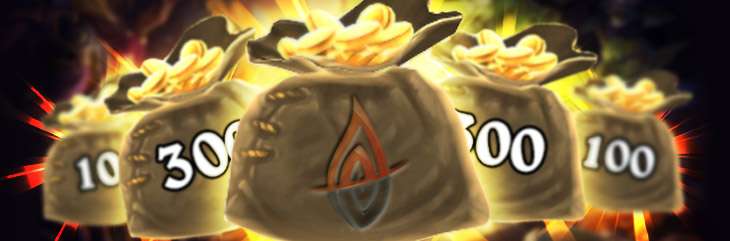
So you don’t really feel like spending money. No big deal! This game gives you a good solid basis for play as-is. On top of that, there are many ways to earn gold in the game:
Rewards
As you play, you will unlock certain achievements. The earliest achievement you might find is winning all practice quests. Doing so will net you 100 gold. Also, by virtue of winning three games, you will get 10 gold. So keep playing and you will find rewards laying around.
Daily Quests
Daily quests reward the player with an amount of gold specified in the quest. Which quest you get on a given day is random, but the reward is the same each time for each quest. You can store up to three daily quests before you have to start completing them. You can also abandon a single quest a day, replacing it with another quest immediately. Complete these quests and reap the rewards! Below is a table of these quests:
| Title | Objective | Reward |
|---|---|---|
| [Class 1] or [Class 2] Victory | 40 gold | Win 2 Games with [Class 1] or [Class 2] |
| [Class 1] or [Class 2] Dominance | 60 gold | Win 5 Games with [Class 1] or [Class 2] |
| Destroy Them All! | 40 gold | Destroy 40 minions |
| Only the Mighty | 40 gold | Play 20 minions that cost 5 more more |
| The Meek Shall Inherit | 40 gold | Play 40 minions that cost 2 or less |
| Spell Master | 40 gold | Play 40 spells |
| Beat Down | 40 gold | Deal 100 damage to enemy heroes |
| 3 Victories! | 40 gold | Win 3 games with any class |
| Total Dominance | 100 gold | Win 7 games in any mode |
Crafting
As you obtain cards, sometimes you will get duplicates. Sometimes you will get cards that are just not worth keeping around as much as the dust is worth to you. These cards can be disenchanted at any time. Disenchanting cards yields “dust.” This dust can be used to craft any card of your choosing, granting you have enough dust to craft it. It’s a fantastic way to keep cards flowing in and dealing with excess cards without having to trade with other players.
Now What?
You’ve read this far and you still haven’t played? Flattering! Still, this is a game, afterall, so you really must get out there and play it to learn best. Here’s a few things to keep you occupied:
Practice
Practice mode unlocks each hero. If you defeat the practice mode version of that hero, you can then play that hero. In addition, once you unlock all the heroes, you get a nice reward. There’s also an expert practice mode, which if you defeat all the heroes in expert mode, you gain yet another reward (hint: it’s gold).
Casual Play
While the computer is a neat way to cut your teeth, playing other people will really test your mettle. It’s highly advisable that you begin your journey in playing others by using the “Casual” setting of the game. This wont impact rank whatsoever, and gives you an amazing variety of players from all ranks.
Ranked Play
So you’re really wrecking face in casual play. Now you want to earn your glory on the fields of battle. This is where ranked play comes in. Every match you win increases your rank. Likewise, every match you lose decreases your rank. Each rank has a star. When you’ve filled all the stars in your rank with a win and you win once more, you move on to the next rank. Beware: If you lose a game, you can lose your rank as well. If you win multiple times in a row, you get a winning streak bonus star, too! Once you’ve gotten past all the ranks, you can progress into the “Legendary” rank. Legendary rank is MMR rated, and it will tell you in your icon exactly how good you are. Legendary players are all competing with each other to obtain the number one spot in their region for that season.
Good luck, and godspeed!
Arena
For 150 gold or $1.99 USD, you can enter the arena. In the arena, you are given the choice of three randomly selected heroes. Pick a hero and now you are given 30 rounds of 3 cards. You must pick one card per-round to build a complete deck. Each of the three cards are selected at near-random, though, so people have some very esoteric decks. Also you cannot see what cards you can pick in advance. In arena, you can have more than 2 copies of a card in your hand, as well! This makes things even more interesting. The goal in arena is to get 12 wins before you get 3 losses. If you lose 3 times, you are given a reward based off of how many wins you have. If you get all 12 wins, you reap large rewards. Rewards scale with your wins, so try your best!
In Summary
Hearthstone looks to be a big hit. Blizzard has seen the steam it’s gained and has recruited huge amounts of staff to support the game. Expect to see many future updates, and please, enjoy yourself. Remember, this game is about practice, skill, and good decision making. Ok, there’s a bit of luck in there, too. Nonetheless, it’s a great way to spend some time and feel really accomplished and challenged in doing so. Have a blast, and may the RNG be with you!
SIMILAR ARTICLES



“Stealth — Can’t be attacked or targeted until it deals damage, has damage dealt to it, or stealth is broken via Flare.”
well, that’s just wrong: minions don’t lose stealth when damage was dealt to them. also, Mass Dispell could be mentioned along with Flare.
“Title Objective Reward” columns are kind of messed up.
What Alpas said.
Also, your “Enrage” short description is misleading and incomplete. A minion is enraged AS LONG AS it’s current health is not equal to its maximum health. There is no “default enrage”. Enrage effects are various in size and shape. For simplicity’s sake you should at least point out that an Enrage effect is LOST if the minion is restored to full health!
Both of these are absolutely correct. I will talk to Simon about editing the article. Sorry for the inaccuracy, this was pulled together in a matter of a few hours the night it was published. Thanks for helping us make this article more solid!
This guide is awesome. I’ve recommended it to a lot of people, and they’ve been very happy.
There should probably be something slightly more substantial here about decks and deckbuilding - after reading this it’s not clear how many cards are in a deck, how many duplicates are allowed, etc.
I believe this is planned for another complimentary guide, as we build out our beginner section Very good idea!