








Deck Building In-Depth: Tempo Rogue
Author - Puffin on: Twitter | TwitchTV - Team: Clarity Gaming | Twitter
My previous article on Clarity Gaming’s website; Deck Building Overview, gave you a general oversight on how to approaching deck building for the various Hearthstone formats. This article will focus on how to go about the process of creating and modifying a specific deck type based on the cards you have available, and the type of games you will be using the deck for. It will focus on constructed play and show you how to speed-up, slow-down, and cater your deck to counter other decks that you will be playing against. I will be using the standard or tempo rogue as the example for this piece, but the principles behind it can be used for most other decks, with some decks having more flexible card slots than others. The tempo rogue deck’s focus is controlling the board while applying pressure to the opponent with minions on the field and weapons with the potential to burst as a finisher. The deck can be modified to achieve more or less of these kill conditions depending on the type of decks you are aiming to counter.
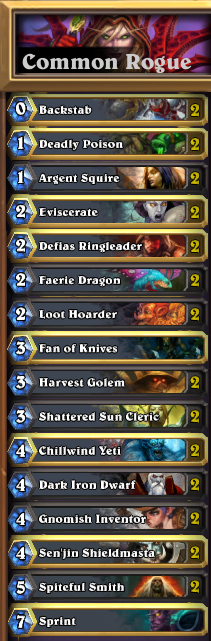
Common Rogue
This is an example of a common rarity tempo rogue deck. It only contains cards of common and basic rarity and is a good starter deck for aspiring new tempo rogue players that want to see if the playstyle of the deck is right for them. The deck has a lot of the core early removal cards that are needed to establish early board dominance such as Backstab, Deadly Poison and Eviscerate. It has decent card draw in the form of Loot Hoarder, Fan of Knives, Gnomish Inventor and Sprint. It lacks a bit in Area-of-Effect (AOE) cards, running only 1 Fan of Knives, but it makes up for it with all of the cost effective minions and buffs that allow you to trade up effectively to help gain card advantage. It does not run any of the big blowout cards, but it’s an efficient and consistent deck that should be able to win you a fair amount of games. Key cards that you want to mulligan for in this deck include all of your 0-2 mana cost cards. An ideal opener includes Backstab to help you proc combos with Eviscerate or Defias Ringleader. Keep in mind that The Coin is also considered a card and will activate combos as well. Coining out a Defias Ringleader on turn 1 is a strong play that can help give you the early tempo to continue with the game. Other great openers include Argent Squire on turn 1 followed by coining out Shattered Sun Cleric on turn 2; Coining out Harvest Golem on turn 2 followed by SSC on 3; Faerie Dragon on 2 followed by SSC on 3; and Dark Iron Dwarf on an Argent Squire, Loot Hoarder or Harvest Golem to trade up on a 4 health creature like Armorsmith, Frothing Berserker, Unbound Elemental and the like.
Rare Rogue
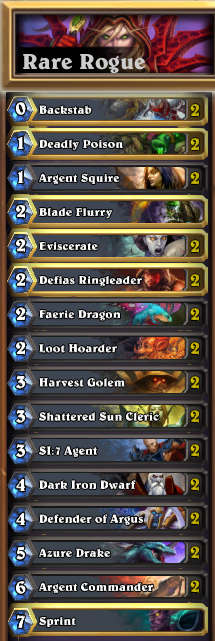
Next, I will show you the upgraded version of the previous deck that includes cards of rare quality when you have gotten enough dust or cards to be able to make this. It is still a relatively cheap deck to make and packs a lot more punch than the previous versions. The 4 key additions to this deck are Blade Flurry, SI:7 Agent, Defender of Argus and Azure Drake in place of Fan of Knives, Gnomish Inventor, two of the other 4 drops. The 4 mana slot cards are all flexible and Chillwind Yeti, Sen’jin Shieldmasta, and Dark Iron Dwarf can all fill the spot depending on the situation, although Sen’jin does overlap a bit with Argus. Argent Commander is a solid 6 drop, but has been slowly going out of favor for other more impactful large drops, mostly legendaries.
This deck plays very similarly to the common version but packs much more punch. The SI:7 Agent gives you another solid 3 drop that also acts as strong early removal (particularly when combo’d with The Coin on turn 2, or with Backstab on turn 3). Blade Flurry combo’d with Deadly Poison can help clear a board very effectively. Azure Drake gives you the spellpower to make your removal spells that much more effective. Argus gives you yet another buff to make your early creatures much stronger (Argus with Argent Squire on turn 5 with another minion on the board is a great tempo swing). Argent Commander often trades 2 for 1 and helps put pressure on your opponent with extra burst. This deck mulligans similar to the previous one except that you should keep SI:7 Agent in your opener if you have The Coin, or a Backstab in hand.
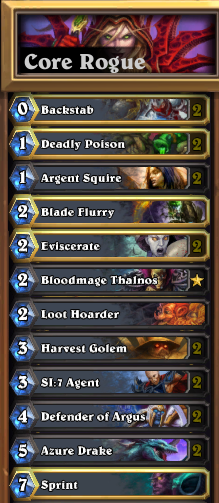
Core Rogue
So you’ve seen the evolution of the common tempo rogue deck to incorporate rare cards. From here, the sky’s the limit to how you want to modify the deck if you have all of the cards. You can create a deck that works better in the late game, better in the early game, more general overall, more weapons focused, more minion focused, more combo focused, more bursty. The Core Rogue deck only includes 1 legendary card, Bloodmage Thalnos, since it is so key to impacting all of the rogue’s damaging spells and helps you cycle a card as well. Here’s the Core Rogue deck. It consists of 20 cards, leaving you with 10 cards of flexibility to tweak your deck to the many different versions that I will illustrate below. There is only 1 Loot Hoarder shown, and most decks can also run 1 of Azure Drake or Argus, and some may choose to drop a Sprint, but overall, most tempo rogue decks run all of these cards. Some key variations may drop some or the others to make room for other cards for their style, but this is a good general starting point to creating any effective tempo rogue deck.
Card Considerations
Legendaries - Leeroy Jenkins, The Black Knight (TBK), Edwin VanCleef, Cairne Bloodhoof, Ragnaros the Firelord, Harrison Jones, Sylvanas Windrunner, King Mukla, Captain Greenskin.
This is somewhat in order of preference. Leeroy is a great finisher card and average removal card that can sometimes sit in your hand and be a bit situational. In fact, most of the legendaries besides Cairne and Ragnaros and Sylvanas are mostly situational since you need a specific board state to be able to gain good value out of them. The 3 legendaries mentioned above all add great board presence and late game pressure. VanCleef can be used as both an early game or late game threat. King Mukla is a great early game threat on an empty board but can have a big downside. Captain Greenskin can be useful in weapons-based decks to provide extra sustained damage and is a good 5 drop. And finally, TBK and Harrison Jones are key counter cards that can be potential blowouts.
Anti-Aggro Cards - Defias Ringleader, Perdition’s Blade, Loot Hoarder, Faerie Dragon, Earthen Ring Farseer, Shattered Sun Cleric, Sen’jin Shieldmasta, Fan of Knives.
These cards help you fight for early board control against other aggro decks. Farseer and Sen’jin help you with sustain and dealing with early threats. Perdition’s Blade is best included with decks that run Amani Berserker and Spiteful Smith as you can enrage them on your own with the Perdition’s ability (you can also use Backstab for this). Fan of Knives was more prevalent when Blood Imp was popular, but has fallen out of favor a bit in tempo rogue due to the more impactful Blade Flurry, but it can still help to remove pesky divine shields and gives you card draw and can be very powerful if you have spellpower effects on the board.
Counter/Situational Cards - Big Game Hunters (BGH), Harrison Jones, Acidic Swamp Ooze, Assassinate, TBK, Sap, Cold Blood, Shadowstep, Ironbeak Owl, Spellbreaker.
These cards are specific answers to various decks. The minions with battlecry are the most effective, and they can be recycled with Shadowstep or Pandas to get more out of their effects. Cold Blood and Shadowstep can also work with Leeroy to use as a good finisher, and Cold Blood can be used on other minions to help with burst or to be used as removal. Decks tend to run the more specific counters than Assassinate due to its high mana cost and it not having the added benefit of placing a creature on the board.
Anti-Control Cards - Spiteful Smith, Sylvanas Windrunner, Ragnaros, Faceless Manipulator, Sap, Sprint, Big Game Hunter, TBK, Harrison Jones, Assassin’s Blade, Captain Greenskin.
These are the cards that help in control matchups. Sap is a great tempo card and can help you push through damage along with TBK. Assassin’s Blade combined with Spiteful Smith or Deadly Poisons can help you do a ton of late game damage to help you fight through the sustain that a lot of control decks are capable of in terms of heals and armor. Sprint gives you the extra ammunition you need to be able to keep up with the card advantage that your control opponent will inevitably get when you run out of gas from your cheap and effective early cards. That second wind will often be enough to help you push for that win.
You want to take the 10 open card slots and fill them with the type of deck that will suit your needs. Keep in mind that the more situational cards that you place in your deck the less reliable it will be, but it will also give it a higher blowout potential and greater ceiling for when you do have answers to your opponents big threats. If you have an idea of the type of deck you want to be countering with this deck then you can either speed up your deck with more anti-aggro cards, or slow down your deck with more anti-control and situational cards to help edge out those victories. Below I will show you the tempo rogue deck that I am currently running and explain the reasoning behind the card choices and talk about key matchups.
Tempo Rogue
This is my current tempo rogue deck. It is currently tuned for the ladder and is very balanced and has a good chance to win versus most matchups. It is strong against aggro/board control warlock decks and shaman. It is weak against aggro hunter decks, miracle rogue, and has slightly unfavorable matchups against control warrior, handlock (giants warlock), and druids. The last three matchups are all easily winnable though if you draw your key counter cards for the respective matchups early enough.
Key card explanations:
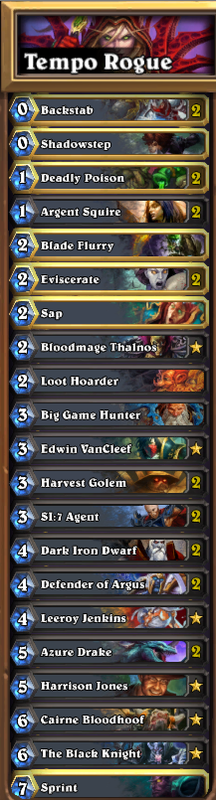
- Shadowstep over Cold Blood - I found that Cold Blood was mainly used as a finisher with Leeroy or early in the game as removal or extra burst damage. Shadowstep gives you 2 more damage with Leeroy for 1 more mana (which you generally have extra of later in the game) and also lets you recycle your key blowout removal cards such as BGH, TBK, and Harrison Jones, along with being able to beef up VanCleef and be able to reuse other useful battlecry’s like SI:7 Agent, Dark Iron Dwarf, Argus, and even Azure Drake for the card cycle.
- Sap - This can be a huge tempo swing cards in most matchups. It is especially effective against greedy druid players that will aggressively innervate out creatures like Carine or Yeti. It also helps you remove a taunt that can help you push through damage.
- BGH - Makes the handlock matchup winnable and can be combined with Dark Iron Dwarf to take out 5 or 6 attack creatures like Ancient of Lore or Fire Elemental.
- Edwin VanCleef - A versatile card that can apply early pressure (Coining VanCleef for a 4/4 is a good tempo play) or late game value (make use of all of your cheap cards late game to get a beefed up VanCleef, generally it’s best to keep him as a 6/6 to avoid making it a BGH target).
- Dark Iron Dwarf - This card is great at buffing your early minions like Squire, Loot Hoarder and Harvest Golem. It also has synergy with BGH. This slot can easily be replaced with Chillwind Yeti for a more beefier minion, or Sen’jin Shieldmasta to provide a more reliable taunt than Argus to help with aggro or burst matchups.
- Leeroy Jenkins - This card is a bit inconsistent, as it mainly serves as a finisher, but it can be an effective removal spell as well, and can help you give you the burst you need to finish games against control warrior, druids, handlock, and aggro races.
- Harrison Jones - This is a completely meta choice with the number of hunters, warriors, and other rogues on the ladder. It can even help against handlock if they happen to Jaraxxus you.
- Cairne Bloodhoof - This is a slower card that is bad in aggro matchups, but can help in most control matchups, particularly control warrior that tends not to run silence, to help you give that card advantage edge and pressure that you need to win.
- The Black Knight - Helps to push through damage and can be a potential blowout card in matchups against ramp druids and handlock that runs a lot of taunts. This is kind of a dead card against aggro hunter, but it can still be helpful versus aggro warlocks that generally run Argus.
- Sprint - Not a great card versus aggro as you will not often have a free turn to be able to sprint without losing the board, and the games are generally decided before then. But this is a key card against control decks to help give you that second wind that you need to be able to finish off your opponent after you burn out of your initial hand.
Conclusion
So that’s the tempo rogue in a long nutshell. I hope this in-depth overview of this deck will help you in your adventures in trying it out. This is a very fun play-style with a lot of decision-making and counter-play and can handle itself well on the ladder or in the tournament scene. I also hope I gave you some insight on how to properly tweak the deck to make it achieve different things and be a better counter for the types of deck that you expect to be playing or to adjust for the current meta on the ladder. If you’d like to see the deck in action or have any questions about how to play the deck, feel free to drop by my stream the next time I’m streaming. Thanks for reading! The pleasure is mine. 
SIMILAR ARTICLES








Wow!
I really enjoyed this artical, It covered things that I’ve personally looked into and many I haven’t, This is by far my favourite article in along long time.
Rogue and Priest are my two favourite classes to play, Miracle is my favourite list, but after that, Tempo Rogue is a close second, Especially for laddering, every season I climb with it.
This article was very in-depth, covered a wide arrange of topics and genuinely had me thinking hard about the list I’m currently running,
Thank you for this,
Genuinely!
Mac