








Basic Deckbuilding: The Drawing Board
Author: Andrew ‘The Water Boiler’ Klawitter
Drawing extra cards is always a good thing, right? In this interview, we analyze and challenge the idea that “one can never draw too many cards.”
In many competitive card games, drawing cards gains access to additional choices of play. This is often considered one of the fundamental aspects in becoming a better player. However, the drawing mechanic needs to be 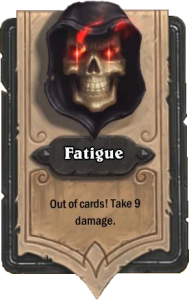 considered in its full context. The designers of Hearthstone have two major imposed limits to the card drawing mechanic; maximum hand size and fatigue.
In Hearthstone, a player cannot have more than ten cards in their hand at any one time. Attempting to draw a new card while already having a full hand results in that card being destroyed. This may seem like a fringe occurrence if you are drawing one card and in return playing at least one card per turn. However, once you begin introducing certain card combinations in both Constructed and Arena play (Starving Buzzard + Unleash the Hounds being my favorite) you will end up destroying your own cards inadvertently at times.
The other negative result of drawing too many cards is Fatigue. Fatigue stipulates that if you run out of cards in your deck and attempt to draw a new one, your hero will take damage. Long drawn out games hinge on this mechanic in order to end a stalemate and limit the maximum length of games. If every card you play is exchanged by the same number of cards by your opponent, you will end up in a situation where no cards remain and hero powers are all that is left to expend mana on. At this point, both players begin taking damage in turn from Fatigue until someone succumbs and is destroyed.
Given the fact that the number of mana crystals a player can use generally remains consistent, additional cards in a players hand grants a more varied choice in opportunity as opposed to in additional players. In a combo deck, a tempo based deck or even an arena deck an increase in cards acts as insurance for your deck to perform and function properly. Combo decks require multiple cards to be chained together to form a win condition, thus drawing will help a player to acquire all the necessary pieces from a 30 card deck which mitigates the effect of luck on your gameplay. Tempo based decks use specific cards in both the early and midgame in order to consistently provide maximum impact. This style of play requires a large amount of options to choose from in order to provide the correct pressure on the board.
The drawing mechanic is especially important when discussing Arena decks specifically. As a result of the construction phase, there tends to be a large variance between the power of the cards that you were provided to choose from. By prioritizing the minions and spells that allow you to draw into other cards, a player increases the possibility of drawing powerful legendary or epic cards at the most opportune moment to play them effectively.
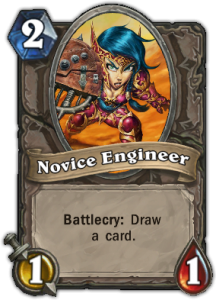 I bring this discussion up in the immediate aftermath of Hearthstone’s recent patch which adjusted the Novice Engineer from a 2 mana, 1/2 + draw into a 2 mana, 1/1 draw. Before you go out and replace all of your Novice Engineers for Loot Hoarders or Nat Pagle, it is my contention that this alteration does little to affect the actual usefulness of the card. The Novice Engineer is not a card which is played as a threat but instead is meant as a 2 mana draw spell that effectively allows a player to utilize a 28 card deck instead of a 30 card deck. While Loot Hoarder and Nat Pagle also give a player the opportunity to draw a card at the cost of 2 mana, they do so at a considerably slower speed. As a result, they are not ideal for a tempo style deck, especially if you’re looking for an answer to a threat THIS turn, such as a Hex or Polymorph that you have not yet drawn.
At the beginning of this article, I mentioned that the negative effects of card drawing are built into the game system. As a result, if your deck is made to draw additional cards, you cannot settle for single card exchanges. Since you have a selected specific cards with the intention of using them to draw additional threats and options, if you are consistently expending a single card in hand for a single card on the battlefield you will run out of cards faster than your opponent. As was mentioned before, running out of cards leads to fatigue which directly lowers your health.
Given the previous, that begs the question of exactly what is the correct amount of card drawing that should be included in a deck? This is a difficult decision that allows players to test and show off their skills at deck building. For me personally, I prefer to run about 4 in my slower decks and anywhere from 10-12 in combo/aggro decks.
How many do you tend to run per deck? Do you prefer to draw during your own turn, or off of a deathrattle trigger? In addition, there are a number of cards that reward this style of play, from Twilight Drake and Mountain Giant to less obvious cards like Violet Teacher and Questing Adventurer. What are YOUR favorite cards to chain together with an 8-10 card hand? Let us know in the comments section!
Lastly, as an exciting experiment I challenge you to build a deck where half of your cards contain the word “draw” in its text. This shouldn’t be difficult as there are up to 20 possible neutral cards that can be included as well as about a handful for each class. As a real challenge, make a deck that utilizes a full deck of draw cards!
SIMILAR ARTICLES








I’m by no means a good deck builder, lots of times I just throw cards that I like in and go by trial and error till it feels ok, but when I’m not bored(on my main deck usually) I’ll start with the core cards that I want in, including my win conditions, some means to make the win conditions able to do what they have to(for example reach the late-game with a decent board presence then drop some big guy) and then try to consider my mana curve and add card draw to compensate.
In general you’ll be able to spend 55-56 mana till turn 10 depending on coin, and then you have 10mana/round to spend. The main aim should be to get enough draw so that you’ll line up your drawing of your final card with having enough mana to spend your cards.
I’ll use my current main deck(it’s quite unrefined yet, but it feels pretty ok so far):
My mana curve is:
0-6-7-4-5-2-2-4
Which requires 106 mana to cast every spell.
I will available 55 mana by turn 10 which takes another 6 turns for me to have gone through enough mana to cover my deck’s cost. After that the more it draws out the more unspent mana(and thus less than optimal rounds) I’ll have accumulated. If you count using fireblast once per turn past turn 10 and another ~4times till that point that’s another ~24 mana till turn 18. Starting with a hand of 3 cards and drawing 1 card per round with 0 draw will take me 27 turns to draw my deck, which means i’ll have wasted 90 mana(that’s almost as much mana as my whole deck takes to cast). So I need to draw ~9 cards to hit an equilibrium. Currently I have a card draw of 7 which makes it feel smooth enough, though I’ve found myself in need of a card draw a few times in the past.
That’s a control deck though, on aggro decks I think the situation is a little bit different.
Aggro decks aim to win in the early to mid game, oftentimes before turn 8-10. Adding draw mechanics in the deck has a tempo cost, so while in theory you can draw your deck faster, having a card that draws another card in your hand often leaves you wondering whether you would prefer an actual card that would put some pressure in it’s place. I think that for aggro decks, getting cards that have an alternative use is much stronger than having extra card draw, because the cost of card draw is always in tempo.
Combo decks also behave a little differently: You win as long as you have the cards that provide you your win condition and enough mana to play them. That means that while you aim to end the game as soon as you can(provided you have the mana that satisfies your win condition) you need to also make use of your hand size to fill it up with pieces of the puzzle.
So, to sum up what I feel about card draw:
1)Combo decks need it the most and they can go a little bit over the top with it as long as they have their combo and enough tools to make them survive till that time, the rest of the cards could just as well be card draw to reduce the deck size and maximise chances of having all the pieces you need to win by the time you can play them. If you have 4 cards that draw other cards in your hand by that time you’ll probably have gone a bit over the top
2)Control decks feel like they come second since you need answers to enemy threats and answers usually come from card advantage, but I feel like it’s best to reach that mana cost/card draw equilibrium where you draw your last card about the time you have accumulated enough mana to play it.
3)Aggro decks require just enough to fill their deck when they run out of good alternatives for their other cards in order to not sacrifce tempo. Locks therefore make incredible aggro decks because they can at will provide card draw if needed without requiring to result to alternatives that will reduce your pressure. A loot hoarder is fine on an aggro deck, but a novice engineer or an acolyte of pain will not deal enough damage to justify their mana cost.
That’s what I believe in general about how to add draw…
As a sidenote here’s my favourite MTG card of all time:(he’s in every deck of mine)
https://gatherer.wizards.com/pages/Card/Details.aspx?multiverseid=106426
I am kind of surprised no one has tried the “challenge” at the end of your article. I thought it was pretty interesting so I gave it a go.
Here is the current list I am running:
https://www.hearthpwn.com/deckbuilder/paladin#7:1;88:2;94:1;100:2;108:2;131:1;206:1;260:2;264:1;280:2;283:2;285:1;293:2;350:2;355:2;360:2;395:2;435:2;
Here is the list I would run if I had all of the requisite cards:
https://www.hearthpwn.com/deckbuilder/paladin#7:1;88:1;94:2;100:2;108:1;206:1;260:2;264:2;280:2;283:2;293:2;350:2;355:2;360:2;395:2;435:2;495:1;506:1;
I’ll explain my thoughts behind the “ideal” deck.
The concept is nothing new, a lot of the deck is based around Holy Wrath (I think Kripp invented this? His stream is where I first saw the deck idea).
x2 Blessing of Wisdom - Draws cards. Can be used on your own minions, but I often use it on my opponents early drops. Sometimes the opponent will decide not to attack with their minion, or trade it straight away to prevent you from drawing more cards. Acts as a pseudo-removal/delay card.
x1 Eye for an Eye - I found myself taking fatigue damage often, so I figured I’d add this card to make my fatigue work against the opponent! Also works with Truesilver Champion to run into their big minions. It is a troll-card, the deck is supposed to be fun and silly, not tournament ready.
x1 Holy Light - The deck is pretty slow, so some heals are sometimes necessary to stay alive. Also good to heal your Giants and Drakes.
x2 Loot Hoarder - Draws cards. Gives a much needed early drop, can trade or make your opponent use their hero power early.
x2 Novice Engineer - Draws cards. Early game drop.
x1 Coldlight Oracle - Draws cards. Can be used to beef up your hand turn 3 before dropping a Mountain Giant or Twilight Drake. Obviously can help your opponent too, so I have thought about replacing this.
x2 Consecration - Gives some much needed AOE vs aggro, not much more to say.
x2 Hammer of Wrath - Draws cards, removal.
x2 Truesilver Champion - Removal and heal, too good not to run.
x2 Twilight Drake - You are drawing so many cards, might as well take advantage of your hand size. Very common to drop with 7-10 health.
x2 Azure Drake - Draws cards. Also gives spell damage, which is good with Consecration, Hammer of Wrath, Holy Wrath. (I think it gives more damage to Eye for an Eye as well, but that might be a bug).
x1 Blessed Champion - I put 1 of these in my deck just to experiment with. My very first game I cast Blessed Champion on my opponents 6/14 Lord of the Arena (it was unranked, OK :P), played TSC and Eye for an Eye, attacked into his 12/14 with us both at 11. My favorite lethal ever, so I figured it deserves a spot, also good after playing a turn 4 Mountain Giant.
x2 Holy Wrath - Draws Cards, a very fun win condition.
x2 Guardian of Kings - High mana cost for Holy Wrath to draw. Heals and delays.
x1 Lay on Hands - High mana cost for Holy Wrath. Can heal your Giants or yourself, draws cards.
x1 Ysera - High mana cost for Holy Wrath. Draws cards WITHOUT taking fatigue damage, awesome!
x2 Mountain Giant - Cast-able on turn 4 with the coin. Keep this in your opening hand. Great since you’ll have such a huge hand. Deals 12 damage with Holy Wrath.
x2 Molten Giant - 20 damage Holy Wrath nuke! Obviously throw this back when mulliganing.
This deck is loads of fun and I recommend you try it out. I did not come up with the original idea, but made this decklist based on the “half of your deck containing “draw” cards” challenge. 15 of the cards contain the word “draw” in the text. Good luck and happy Holy Wrath hunting!