








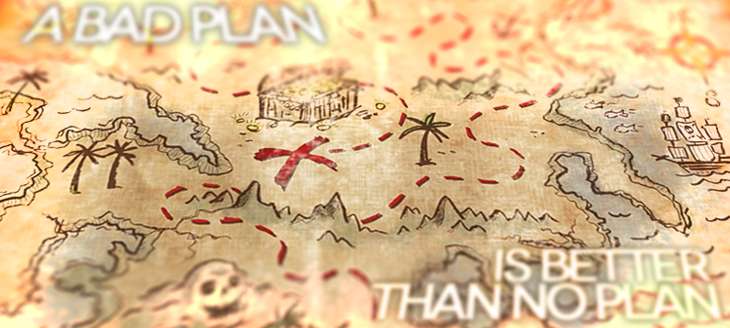
A Bad Plan Is Better Than No Plan
(You can also comment at the bottom of this post, it will automatically synchronize with the forum thread, and vise versa)
ThatsAdmirable - Twitter | TwitchTV | Facebook
When I first started playing games, Magic was the game. All of my friends played Magic in every possible way; booster drafts, constructed tournaments, games where we’d make up cards as we went along that stretched my creative and competitive imagination.
In the beginning, I’d always lose; I couldn’t figure out the game. But my hunger for winning was too much. I had to know how. I began playing chess, with the idea that excelling at chess would help me excel at Magic; I thought it’d teach me how to evaluate a position, get inside my opponents’ heads, and adjust to constantly changing circumstances — in other words, to think strategically. I studied the best players in the world and read about how they all got to the top. When I got to Bobby Fischer, I was fascinated by the idea that he would play games against himself to improve. Magic is a two-player game; I’d previously assumed that I needed an opponent to practice and improve, leading me to feel frustrated when there wasn’t always one around. But there was — me! So I began playing games of Magic against myself.
After a few weeks of this, I realized that since I could see both sides of the game, the only way one of the sides could win was by luck. So I played to get lucky — and I did! I noticed this pattern occurring constantly in games that I felt I was losing. The only way I could win was if I got lucky — but it wasn’t pure luck; putting myself in a position where I could get lucky took a lot of skill. I began using this method against my stronger Magic friends, getting lucky at a much higher rate than I should have been; I would win almost every time my draw was superior from the start, and then win almost every time my draw was worse from the start, because I’d put myself in position to get lucky, and then, eventually, I would!
“That play is so bad,” one of them shouted at me one day.
Him: “How can you just hope to draw that single card?!?”
Me: “How else can I expect to win?”
Him: “You are never gonna win if you play like that all the time!”
Me: “I don’t play like this ‘all the time.’ I’m playing like that THIS time…”
Him: [Ramblings of a frustrated player who didn’t get it]
Variance is a component in card games. It’s just that simple. Any game of some complexity will have an element of psychology, which requires incomplete information, which requires luck — these things are what keep poker and Magicand even Starcraft fresh and timeless fun. At a certain point, luck even bleeds into skill; calculating your best decision based on a vast amount of variables, some of them, like an opponent’s hand or the top of your deck, unknown, is the most interesting thing you can do in games. Planning to get lucky can maximize your skill edge, or minimize your opponents’! And this process of minimizing your weaknesses and maximizing your opponents’ is one of the best ways to get better at games, and fast.
Having solid fundamentals goes a long way in games like Hearthstone. Your cards should be powerful. Wasting cards is (usually) a bad idea. Trading efficiently is a well-beaten path to victory. But what defines power? What makes something wasteful? Why do I need to trade, and when? Questions like these can often answer themselves, but what about when they don’t? After all, the constant difficulty of fighting in new and unique situations is what makes these games the best games. I watch strong Hearthstone players fail to execute their plans on a turn-by-turn basis, and they end up quitting in situations where they have to get lucky to win a game by, say, top-decking two cards in a row.
But why quit if you still have a chance? Decks in Hearthstone are only thirty cards, so you’ll draw your outs often enough to justify still playing. Your opponent might also have an awful hand, too — the element of luck means that it’s hard to get a big edge in a card game (as anyone can win any game), so conceding in a spot where you’re still live to win, even if there’s only a 1 in 100 chance, is a big leak.
Conversely, I also happen to watch a lot weaker Hearthstone players; what makes them weaker is that they come up with bad plans. But in difficult and frustrating situations — a bad draw; a bad position — a weaker player can be better than a tilting stronger player, as a bad plan is better than no plan at all. Hell, sometimes it works! Imagine if instead of planning, our bad player instead just jammed cards onto the board haphazardly. He’ll look like a sad giraffe while he’s doing this, and he’ll look sadder when it doesn’t work. If you ask him what he was thinking afterwards, he’ll morph into an angry hippopotamus — he won’t want to improve! And too many good players limit their improvement by letting their anger overtake them in-game, instead of trying to work their way out of a difficult position when things don’t go according to plan.
People make mistakes; it happens; it’s natural; it’s what makes these games interesting. After all, if games are too easy to play perfectly, we’d get bored of them very quickly. When you lose, ask yourself what you could have done differently. Figure out what you should have done differently, based on the information you had; commend yourself for the things you did right, too, but don’t waste time justifying your previous poor plays.
The best way to improve is to come up with a plan that would have won the game. Remember that every game is different, but also that every position will have similarities with every other position. Take into account that your Mage opponent will likely be able to Blizzard on turn 6. Remember that you don’t want to leave three 1-health minions and one 4-health minion on the board versus a Druid unless you can’t win otherwise, as you don’t want to let him get a perfect Swipe. Remember that your Paladin opponent can Equality / Consecration and sweep out any number of fatties you have on the board. Each game will have new combinations of variables to account for, so you’ll have to think through it, but it’ll be easier to think through it if you’ve played a lot of similar games before — and learned the right lessons from those games. In those new games, even if your thought process is at first poor, and you lose, your mindset will help you win the next game, or the game after that, and get better and better, slowly but surely — just having a thought process is the first step to teaching yourself to improve, which is the only way to get good at chess, Magic, Hearthstone, or any other game.
I recently sat down with a friend at a Chinese restaurant to talk some Hearthstone. He was having a tough time in Arena and wanted some direct help. Watching my stream had helped him go from a 3-3 at best to a 5-3 or 6-3 winner, but he was determined to hit the 12-win mark. We discussed class rankings, card rankings, the works. He was very knowledgeable, but unable to put his knowledge to practical use. He lacked wisdom. As the meal concluded, I began to think about how to communicate this idea to him, when my fortune cookie nailed it:
“If you fail to plan, you plan to fail.”
A bad plan is better than no plan at all.
See you in Arena =]
SIMILAR ARTICLES







excellent article.
knowing your line to victory and your opponent’s most likely line are critical to playing this game intelligently. I always know what I want to do NEXT turn as I hit the end turn button. I then adjust it based on what my opponent plays and what I draw into.
Crisis management is 10% keeping calm and 90% contingency planning. I play HS with that mentality; figure out my best few lines to winning the game and stick with them as best as makes sense. It’s also probably why I prefer full on aggro or control over midrange decks where situations tend to be a bit less rigorous and your ability to execute a strategy will often be impacted by RNG factors or your opponent’s plays.
I will say that I also enjoyed this article.
I think that it is extrememly helpful to both newer and older players. I always start building decks with a plan, whether that be in the Arena or Constructed. I like control, because it benefits me to know my opponent’s deck as well as he does. When you know your opponent, you destroy them. Playing control is so very fun in that way. From the beginning of the game, you can build a roadmap of your turns, and then you can deal with the little interesting plays your opponent might play.
Great article! I have time for a few rounds a day so this will help me come in with a concerted approach to strategy and analysis. Cheers
To add to the point of the difference in good and bad players valuing plans when they lose:
A good plan isn’t about executing itself efficiently, it’s about handling circumstances contrary to the plan more efficiently than it otherwise would have been.
Too many players tilt and go fuck it YOLO and it works against them in the long run.
All very good points! Foresight is a major key to success, and practice will hone your precognition. I’m glad you guys are enjoying it =]
[…] at iheartu.com, ThatsAdmirable, wrote up his mini-guide philosophy on why it makes more sense to attempt to allow […]
Very cool article, can’t wait for the next ones. : )
Keep it up !
This is a really great article to keep in mind while playing. Sometimes the ‘optimal’ looking play won’t win you the game. Sometimes you just have to hope you topdeck the card(s) you need and play to that avenue instead. As Admirable said, with a 30 card deck this happens more often than you’d think.
The advice to look back on played games and think about what you could do differently is also valuable. If you don’t look back you’ll never change, and if you don’t change you can’t possibly get better.
Typo detected: a space is needed on “…poker and Magicand…” between “magic” and “and”.
I published on my blog a resume of this article, in portuguese.
https://coracaopedra.wordpress.com/2015/04/29/um-plano-ruim-e-melhor-que-plano-nenhum/