








Thoughts on Naxxramas Midway Through The Release
Author - Mike Tyminski On: Twitter
With Naxxramas slowly being released in stages, I figured I’d take a look at some of the effects that the newer cards are having on the environment, especially as it pertains to the ladder. Since the set has a gradual release (with about six new cards a week), I figured it would be best to break this article up into two parts as to maintain some semblance of timeliness while also getting a chance to see how specific cards affect the metagame.
Nerubian Egg and Haunted Creeper are better than initially thought: Looking at the spoilers, both Nerubian Egg and Haunted Creeper felt like fringe playables, both seemingly slightly undersized in 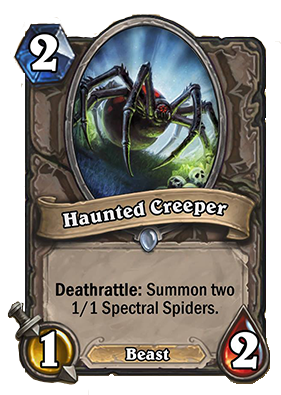 exchange for reasonable payoffs and a little sweeper protection. However, both cards have a starring role in the new zoo decks, which take a much more voltron style approach. This engine how ever is not zoo-exclusive as it’s responsible for a resurgence for midrange shaman, with the same basic engine being used for both - Egg, Creeper, Harvest Golem, Knife Juggler and all the buffs you can grab in order to grind out an easy win.
In general the format seems to favor midrange and aggro decks right now: Based on sheer numbers, I’ve been noticing not only an uptick in Zoo and Shaman Midrange decks, but Hunter Midrange has seemed to come out of the mothballs, trading in the bursty cards that Face Hunter ran for a bigge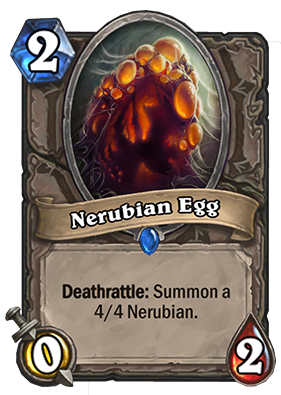 r more beast-centric plan, including setting up huge taunting Oasis Snapjaws, bulky Scavenging Hyenas, and Savannah Highmanes. Druids seem to be split pretty evenly with a slight lean towards token druid, but regardless seem to be forming the primary control axis of the format. You can still see some control in the format, but it’s harder than it was before to have a stable board if only because of the deathrattlers and token minions providing sweeper insurance.
Silence is better than ever: So we have an environment defined by it’s deathrattle minions, Knife Juggler, 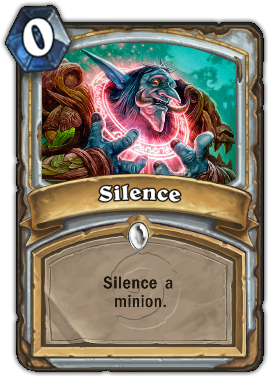 buffing cards like Flametongue Totem and Defender of Argus, and tons of grindy value cards, what are some of the ways we can combat them? Big taunters can somewhat alleviate damage to the face, but the best answer for so many of the defining cards in this format are silencers. Earth Shock and Keeper of the Grove were already some of the most efficient cards in the format and are made more so by the staggering number of juicy targets these cards can handle.
The miracle menace is in decline: By far the biggest loser in terms of meta share since the release of 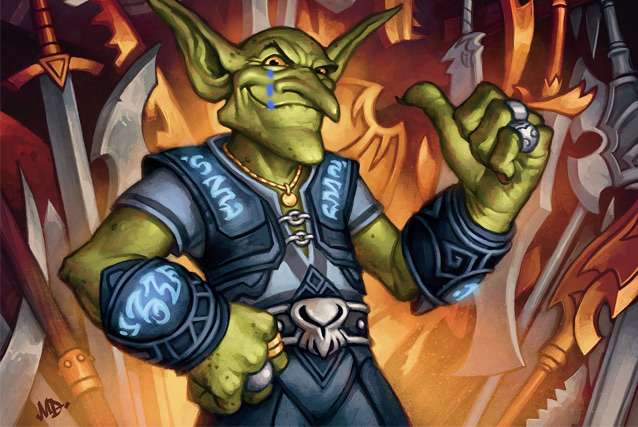 Naxx is Miracle Rogue. This decline is probably caused by it’s weakness to the resilient aggro strategies prevalent in the format. However, since many aggro decks can force the miracle deck to unprofitably use it’s removal spells before an auctioneer can come online, the deck (and it’s predators, such as Backspace Rogue and Handlock) sees considerably less play on the ladder than they were at this time last month. It is however, still ubiquitous at the tournament level (6 of 8 players at WEC’s NA qualifier still ran the deck).
The plague quarter’s cards are middling, but still find a home in the right decks. In addition to week 2’s access problems (I originally planned week 2 to be the cut-off for this article, but I was blue-circled  well into the weekend, so I added some week 3 content to make up for this) we got some taunters that seemed to help stem the zoo tide in Sludge Belcher and Unstable Ghoul. I’ve seen trace amounts of both cards (the Belcher is particularly well equipped for midrange mirrors), but not to the degree that we saw Nerubian Egg and Haunted Creeper from week 1 which seem ubiquitous in decks as diverse as Zoo, Token Druid, Midrange Shaman, and Midrange Hunter.
Loatheb can occasionally be a game sealer, but more often than not it’s just a body: In the couple or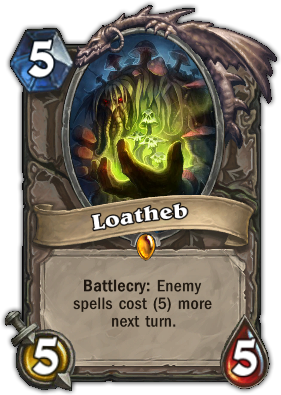 dozen or so games that either myself or my opponent has played a Loatheb so far, it has not been nearly as amazing as the text as made it out to be. While a 5/5 body is nothing to sneeze at (and the card is particularly good in tempo decks), it’s best use seems to be as a game sealing threat, when you need to overextend ever so-slightly in order to win the game the next turn. That being said, should a harder combo deck (a la Miracle) come back into vogue on the ladder, this cards upside potential skyrockets.
Token has been the preferred form of Druid since Naxx’s release: Going into Naxxramas, it seemed like Druid Midrange and Ramp Druid decks were the predominant style of druid, working off of the numerous gradual advantages that the deck could provide, with there being a healthy debate over the degree to which the deck  should lean on the Force of Nature/Savage Roar burst combo. However, a cursory look at the last week or so of tournament results paints a different picture, with Token Druid being the pick of numerous pros since Naxx brought two excellent token producers in Nerubian Egg and Haunted Creeper to further buff the token based strategy and the fact that the deck is able to both grind out a win and burst someone down (with an innervate 30+ damage bursts are not out of the question) with relatively equal prejudice.
The undersized cards with great text are generally seeing more play than the undercosted cards with deathrattle drawbacks: While the format seems to be built around Nerubian Egg, Haunted Creeper, Nerubian Weblord and Sludge Belcher which while initially undersized all leave some value as th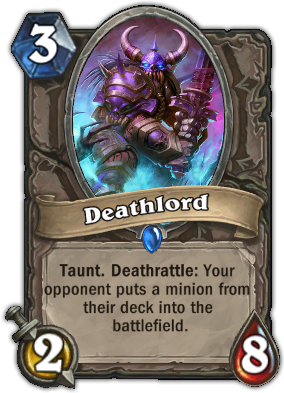 ey leave or otherwise affect the battlefield, there’s a near complete absence of cards like Dancing Swords and Deathlord that have amazing stats for their costs (4/4 and 2/8 for 3 respectively) on the ladder. I think a decent part of that is due to the size of the drawbacks in relation to the size of the minions and the average size of their cost - while deathlord is amazing against smaller aggro decks for example, against a midrange deck it can usually be killed off fairly clean and in turn cough up approximately the same amount of crystals in tempo. Dancing swords meanwhile, does not give enough of a size edge against a card like Injured Blademaster, whose drawback is considerably less severe (and actually can synergize to an advantage) than Dancing Swords.
While there’s variation within classes, Naxx hasn’t done much to affect actual class balance: Naxx has 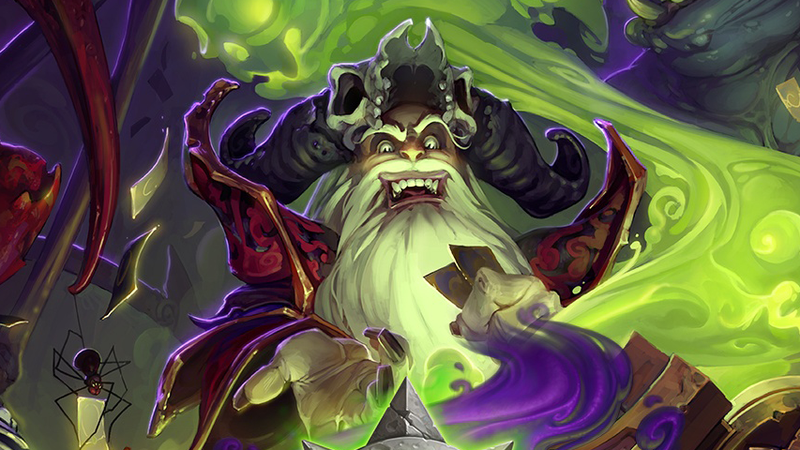 had an undeniable effect on the format, but the one area that naxx has failed to change is the class balance at the highest level. A cursory look at tournament results still shows a heavy amount of Rogue, Druid, and Warlock, with Shaman, Hunter, and Warrior on the fringes and substantially fewer Paladins, Priests, and Mages. The preceding statement, however, would have been completely true even before Naxx. Where naxx has changed the format instead is in what those classes play, with Druid and Warlock playing more aggressively and Hunters playing considerably more controllingly, as decks tend to get pinched towards the middle whereas the burst meta of June and early July tended to require more strictly aggressive and control archetypes.
This might be the first time in the 21 years of TCG’s that a gradual release model worked: Time for a history lesson…way back in the late 1990’s, Wizards of the Coast gobbled up a number of smaller properties from other TCG companies in the wake of the first small collapse of the TCG market. The most prominent two, Legend of the Five Rings and Doomtown were moved to what they dubbed “the rolling thunder” model in which small sets were released on a monthly basis, creating a scenario where collation was a disaster and duplicates of commons often ended up in the same booster pack. The 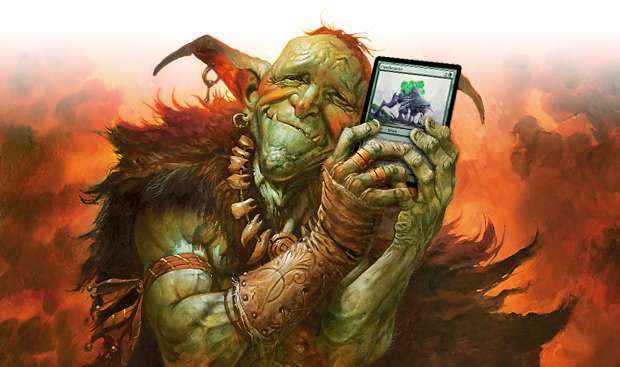 experiment became such a disaster that Wizards abandoned the model within a year, and both properties struggled to recover from the experiment after being shuttled back off to Alderac a couple of years later. However, it seems that Blizzard managed to stumble upon the proper way to fix this problem by literally fixing the releases as quest rewards, thus removing the issues that come with a very small and random set. Additionally, with the internet as a distribution channel and play interface, the metagame moves fast enough that the gradual release model keeps the environment fresh and prevents the set from being solved too quickly, a problem that has started to rear it’s head in the paper TCG realm.
Final Thoughts (for now): As both a means to freshen up the metagame and add some strategic depth to the game, Curse of Naxxramas has been a fine set to do so. While the plague quarter issues were a touch ridiculous (it is pretty frustrating when you end up three days behind while other people on the ladder play with their shiny new toys), pretty much everything else with the set has been enjoyable, from the heroic boss fights to the new cards in the set. I hope that we get to see further changes with the release of the remainder of the set to rival the long term impact we saw from the first half of Naxxramas cards, and I’ll be back in a couple weeks to look over the impact of the second half of cards on the metagame.
SIMILAR ARTICLES








You must be logged in to reply to this topic.