








Team IHearthU Deck Guide: GvG Control Warrior
Team IHEARTHU: Twitter | Website
Sponsored by: Kinguin | Waypoint Media
Introduction: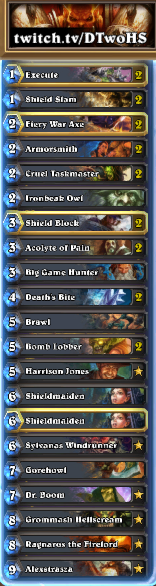
Many players have put their own Goblins vs Gnomes spin on Control Warrior, and this is team IHearthU’s version. Though there are a few modifications, many of the staples - life gain, card draw, fat late-game Legendaries - remain the same. Therefore, the deck plays out much like the old Control Warrior, though we believe the GvG additions we’ve made have significantly improved the deck. Let’s take a look:
Iconic Cards
Since the release of Naxxramus, almost every Control Warrior has run two copies of Execute, Shield Slam, Armorsmith, Cruel Taskmaster, Acolyte of Pain, Shield Block, and Death’s Bite, along with a copy of the Legendaries Sylvanas Windrunner, Grommash Hellscream, Ragnaros the Firelord, and Alexstrasza. The weapons help the Warrior survive the early game, the little guys provide armor and card draw while being annoying, and the big guys help you overpower in most matchups provided you can survive to that point.
The GvG cards we’ve put in the deck are Bomb Lobber, Shieldmaiden, and Dr. Boom. Though it’s only five cards, they significantly change the way Warrior is played. Whereas Sludge Belcher was a completely defensive card, Bomb Lobber helps to proactively take out the opposing minions. Since Warrior likes to use its removal to keep the opponent’s board size small anyway, Bomb Lobber will usually hit the target you want it to hit. Shieldmaiden can hold off aggressive decks and buy you some time while also putting a reasonably-sized minion on the table. In my experience playing with and against Shieldmaiden, it is a surprisingly difficult minion to deal with, particularly knowing that there are bigger minions coming down the line. Finally, Dr. Boom was added as a way to both provide a threat and to help deal with multiple opposing minions. And considering the other minions in the deck, Dr. Boom’s seven attack isn’t nearly as much of a drawback as in other decks.
Ironbeak Owl, Harrison Jones, Big Game Hunter, Brawl, and Gorehowl are all meta-game calls, but we advise running at least one silence for the foreseeable future.
Mulligan Guide:
Weapons are useful against almost every class, though there are some exceptions we’ll get to later. Armorsmith is typically great against Hunter and Paladin, and is a decent keep most other times as well, though Warlock (both versions) is a notable exception. There’s really not much reason to keep any of your removal or big Legendaries, though Brawl can be kept going second against Zoo.
How to Play:
The standard way to play Control Warrior is to stay alive until you can play your big minions and then start to pressure your opponent. However, if you’re very experienced with the class, you can take a more aggressive approach if you’re able to get board control early on. For an example of good aggressive Control Warrior play, watch Neirea’s games against me in the Kinguin For Charity tournament.
How to Play Versus:
 Hunter: This matchup was made better for the Warrior with the addition of Shieldmaiden. After using Death’s Bite to clear their minions, you can usually get off a very good Bomb Lobber and shut them down. Mulligan for Fiery War Axe, Armorsmith, and Cruel Taskmaster.
 Paladin: GvG has made Paladin very strong, so it’s important to be proficient in this matchup. Recent Paladin decks are much more midrange-focused, so it’s important to stay alive, knowing your late-game minions can win the game for you. On the other hand, Paladins don’t run nearly as much heal, so if you find an opportunity to be aggressive, go for it. Death’s Bite is very important in this matchup, and if you find yourself running into lots of Paladins, then tech-ing in a Whirlwind can help immensely.
 Druid: This is one of the matchups where Bomb Lobber is extremely valuable. In fact, he’s worth keeping in your opening hand, as Fiery War Axe typically isn’t nearly as valuable against this class. While it’s still a bad matchup, if you ever find yourself against a Druid that started slowly, pressuring his life total can pay dividends down the line as they might have to use their Combo
Card Combinations:
Shield Block and Shield Slam is an obvious combo; the same goes for Taskmaster and Execute. Actually, Taskmaster can be combined with most other minions in Warrior’s arsenal to make them more effective, including using it on an opponent’s minion to enable Big Game Hunter. Bomb Lobber is effective when used after weapons so you can “target” its Battlecry. Finally, Death’s Bite and Taskmaster are your activators for Grommash to finish the game.
Budget Legendary Replacement Guide:
Unfortunately, this deck is built around its late game Legendaries, so there aren’t really any ways to replace them while remaining competitive. As for the one GvG Legendary, Dr. Boom, you can replace him with Baron Geddon and the result is somewhat similar.
SIMILAR ARTICLES








You must be logged in to reply to this topic.