








PVDDR - Playing to Win vs Playing Not to Lose

Author: PVDDR - Twitter | TwitchTV
For those who don’t know me, let me introduce myself before we start: my name is Paulo Vitor Damo da Rosa (or PV), and I’m a 26 years old Magic: the Gathering player from Brazil. I’ve been playing Magic professionally for the better part of a decade, and I’ve accumulated quite a few good results in that time, including an induction to the Hall of Fame in 2012.
Three months ago, I picked up Hearthstone and I quickly fell in love with it; it was similar enough to Magic that my skillset transferred decently, yet different enough that it still felt like I was doing something new. I started playing, first casually and then a bit more seriously, and I managed to hit the Legendary ranking in my first three seasons, peaking at 15th NA.
On top of playing Magic professionally, I also have a vast background in Magic writing; I’ve written for the three biggest websites in the world, and I currently write for channelfireball.com. I write weekly, so I’ve covered a lot of different topics throughout the years, but my favorite articles are theory pieces that are not confined to a particular deck or metagame. I’ve written about Hearthstone once already, but it was an article aimed at Magic players - you can find it here https://www.channelfireball.com/articles/pvs-playhouse-hearthstone-for-magic-players/. This will be my first article that is exclusively about Hearthstone to Hearthstone players, so I’d really appreciate any feedback that you can have - what you liked, what you didn’t, what you’d like to see more in the future and so on. That said, let’s get started!

“Playing to win” versus “Playing not to lose”
“Playing to win” versus “Playing not to lose” is a concept that I learned from Magic (which is true for basically all my Hearthstone concepts), and one that I think translates particularly well between the two games. In my opinion, there are two possible goals when you’re making a play - you either play to win the game, or you play to not lose the game. Playing to win means you make the play that is more likely to, well, win the game. Playing not to lose means you make the play that is less likely to cause an immediate loss. They might seem the same, but they are in reality very different, and in many games of Hearthstone you have to identify which style you should adopt.
 The decision to play to win or not to lose begins with deck choice, and in this regard there is some personal preference involved. A deck like Freeze Mage, for example, is a deck “to win”. If your goal is not to lose, then it is a poor choice, because you can get paired against Control Warrior and you will just flat-out lose. Decks like Hunter, Zoo or Priest, on the other hand, will have bad-matchups, but they won’t be astonishingly bad; you will get less free wins but will also be handed out less free losses. By picking those decks, you aim to “not lose” instead of winning and, once you’ve “not lost”, you can figure something out from there.
In tournaments, this effect is magnified. It’s rare that you will want to start a tournament with a deck that is very hit or miss - the way I see it, the ideal mindset is that you don’t need 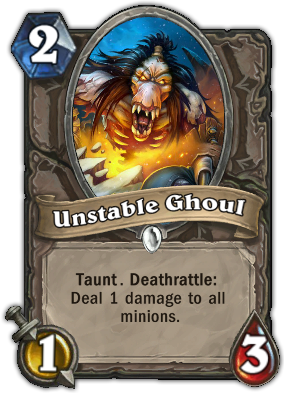 to dominate your first round, all you need to do is make sure you have a fighting chance against everyone - choose the hit or miss decks once you have more information. In general, I think good players tend to prefer decks that “don’t lose”, because they want to be able to influence their win percentage with what is theoretically superior playing. In a tournament where you have to keep the same deck and someone can just choose a different deck to play against you, you want to make sure that there is nothing they can do that you just can’t beat, and this usually comes at the expense of not “just beating” anything they do either. In other words, I believe that, if you think you have an edge in playskill, you should choose three decks that have roughly 50/50 against the field over three decks that are either 100/0 or 0/100; in this case, you should play not to lose.
Once you have an archetype, the decision of what you put in your deck is also going to be guided by whether you are playing to win or not to lose. The key principle here is that, you can only play not to lose if, by not losing, you win. This means that there has to be some mechanic, something in the way your deck is built, that leads you to believe that, if the game goes on, you’ll eventually emerge the winner. The most common of those things is simply having late-game cards. This is the reason that most control decks have many legendaries, and most aggro decks do not; control decks play not to lose, so that they can get to a point where winning will be academic. In turn, they can afford to play cards like Unstable Ghoul, Backstab, Mortal Coil and Earthen-Ring Farseer, because they know that, if they don’t lose, they win by default - even if they have those cards in the late game. Aggro decks, on the other hand, play to win, because they know that, if they haven’t won by turn twenty, drawing a random Alexstraza won’t help them.The key principle here is that, you can only play not to lose if, by not losing, you win.
 Take, for example, Control Warrior. Control Warrior is a deck that runs a cards like Unstable Ghoul, Cruel Taskmaster and Armorsmith, and it often spends its entire turn using Hero Power rather than increasing its board presence, on the assurance that, if the game goes long enough, nothing is really going to matter. How does it have such assurance? Because it plays Baron Geddon, Sylvanas, Ragnaros, Ysera, Grommash, you name it. For the Warrior player, “not losing” is a kill condition. Now, take a deck like Aggro Paladin - with that, your win condition is actually killing them, rather than not dying - if both players “don’t die” by turn 15, then you don’t win by default - you very likely lose by default.
Can the Warrior deck still lose the late game? Of course it can, but it’s not likely. If you have reason to believe you will not, in fact, win the long game, then you need to change gears and play to win the game instead. When you build your deck, keep in mind whether you think you can win the late game or not against different decks; something as simple as one Mind-Control in your Priest list or one Ysera in your Warrior deck could enable you to play the game in a completely different way.
Another thing in Hearthstone that will make you able to play “not to lose” is a mismatch in hero powers. If I’m playing Hunter against Priest or Warrior, we’re evenly matched; every turn I’ll deal you two damage and you’ll gain two life back. If I’m playing Hunter against Rogue or Mage, however, I know that, every turn that passes, you’re taking one more damage than I am. If the game lasts fifteen more turns, I am going to win. This means that, if you are the Rogue or the Mage, there has to be a point where you need to go for the win. If you’re the hunter, not losing is OK.
This dynamic is what makes the Freeze Mage versus Hunter matchup so bad (well, that and Flare). Freeze Mage is a deck that specializes in not losing, but it actually gets trumped by the Hunter hero-power if the game goes long enough, so it has to try to win the game. The problem? It can’t really win quickly enough; none of its cards do anything! What are they to do, try to ride Novice Engineer all the way from 30 to 0? They are forced into a “not losing” play because that’s all cards like Doomsayer, Frost Nova and Ice Block do, but they are actually playing against a deck where, if they don’t lose, they don’t win!. It breaks the fundamental rule - to play “not to lose”, you need to make sure that, if neither player loses, you will emerge the winner.
 This is, incidentally, what I think makes Hunter so strong. Hunter is a deck that tries to win, but, if it can’t, not losing is also OK. It’s basically the only aggro deck where this is true; if you’re playing, say, aggro Paladin, if you don’t win, you really just lose. With Hunter, you get all the free wins from having a lot of pressure but, if you don’t get those free wins, it’s not so bad. You play cards like Unleash the Hounds and Traps, that strongly punish a forward play-styles, but if the opponent plays around those cards, he’ll just give you time to Hero Power them out. The combination of being able to win if you win and also if you don’t lose is very powerful in the current metagame and Hunter is uniquely positioned in this regard.
Most of your decision points on this matter will be inside the game. You could, theoretically, set your choice before you even begin playing and then always follow that - i.e. “I’m playing Control Warrior so I’ll always make the choice that leads me to not losing” - but that’s not optimal. You need to analyze every situation and decide if it’s ok to play not to lose. Basically, every time that you can play not to lose, that’s preferred; but, if you can’t, then you must play to win.
As a general rule, if you are winning the game comfortably, try to think of ways you can lose the game. Put yourself in the opponent’s position and think - what can his plan be? How is he possibly thinking on winning this game? What does he hope I do? - and then don’t do it! If a Priest is at two life and you have  ten power worth of Holy-Nova-proof attackers, then you should very likely not play Ancient of War, because one of the ways you can lose is if they Mind Control it. Sure, not playing it might lose you some games - maybe there is a 3% of the time where their two cards are exactly Auchenai and Circle of Healing and they draw the other Circle of Healing and suddenly you have no board, and then they draw Shadow Word Death to kill your Ancient of War and you draw two Innervates in a row and end up losing exactly because you didn’t play it - but the likelihood that they just Mind Control it and win from there is much bigger. If you’re playing against Hunter, don’t flood the board with unnecessary minions, because those extra Unleash the Hounds tokens (and cards!) might be just what gets them back in the game. When I am playing Hunter, I often think “please play another minion please please”, so you can be sure your opponent is also thinking that; if you believe they are, don’t do it!
If you’re losing the game, however, then you need to do the opposite - look for ways to win. Imagine you’re playing Druid against Zoo and they have a 20/20 Void Terror; you are at 21 life and they are at 8. You draw for your turn a Druid of the Claw. Now, you could play “not to lose”; if you play Druid of the Claw in Defender mode, it’s not likely that they can kill you; they’ll probably just kill Druid of the Claw. So you’re safe… for that turn. Except you’re not really going to win the game, are you? There’s nothing in your deck that can make you beat a 20/20 even if it’s forced to sit back for a turn. You need, therefore, to identify a way to win the game, and that way is playing Druid of the Claw in charge mode and attacking for four, and then topdecking a Swipe or a Force of Nature. If they draw Soulfire, Abusive Sargent, Doomguard or anything like that, you lose on the spot, but so what? You weren’t winning anyway. You are betting a very small amount (a game you were almost surely going to lose) for a huge potential gain (you win a game you were almost surely going to lose). Giving yourself a small chance is better than no chance at all, and delaying an inevitable defeat doesn’t accomplish anything. If you’re dead, go for the win.
 Playing not to lose doesn’t have to be something as drastic as losing the game on the spot. Imagine your Hunter opponent played a turn two Haunted Creeper, and you have a 2/2. Normally you don’t want to attack into Haunted Creeper - it will just cause them to get two Spiders and then kill your 2/2 on the way back. However, what if they Coin + Houndmaster on turn three? It’s possible that this play is too hard for you to beat, in which case it’s OK to play it safe and just kill their guy - you are making a theoretically worse play, but one that acts to prevent a very bad outcome. In this spot, by attacking it, you’d be playing not to lose. Look at it like making a play that is always a “4” on a 1-10 scale, as opposed to making one that could be either a 7 or a 1. Sometimes, all you need is a 4, but you can’t afford to get a 1, so why roll the die?
There are two main pitfalls that I think people fall into when deciding how to play. The first is that they forget to make sure that, by doing things in a certain way that prevents you from losing to one thing, you aren’t losing to something else that is more likely. Imagine you are playing Priest against Warrior, and you have a Shadow Word Death in your hand, facing down a Loatheb. Normally, you don’t want to use Shadow Word Death early, because they have targets such as Grommash, Alexstraza and Ragnaros - it’s usually OK to take some damage from the Loatheb in this spot. This would be playing not to lose; you don’t want to kill the Loatheb and then be just colded to an eight-drop in the following turn. I would consider this the default play from the Priest deck. There will be spots, however, in which you must identify that, if the Loatheb lives and they do draw Ragnaros, you’re probably not going to win anyway. In those spots, playing “not to lose to Ragnaros” is not OK, because it will just result in you losing to the Loatheb - and you don’t know if they have Ragnaros in hand, they might not have it, whereas the Loatheb is already there.
 A couple days ago, I was playing the VGVN tournament and I played a very interesting Handlock versus Warrior end-game. It’s quite complex, but the moral of the story is that I felt like I was very much ahead and needed to identify ways to lose the game, and eventually came up with a topdecked Ragnaros for him that could lethal me out. I got so focused on the fact that I didn’t want a potential topdeck Ragnaros to kill me that I went through some hoops to stay above eight life (which included, for example, suiciding my Bloodmage Thalnos before playing Hellfire), and, when he actually topdecked the Ragnaros that turn, it ended up shooting one of my two Molten Giants and creating a scenario in which I could never win the game. By doing what I did, I made sure I’d survive if he hit me, but I’d lose the game in the other 2/3rds of the time. If I stay at eight life, then I make sure I kill him even if he hits one of the giants - a 66% chance, twice as much as the play I made. In that situation, I got so focused on “I need to find ways not to die” that I failed to consider if I would actually win the game playing like that; I found the play that wouldn’t lose to Ragnaros to the face, but that play ended up losing to something that was actually more likely to happen.
The other pitfall is that people use “playing to win” as an excuse to make bad plays. You must be careful not to go too far. Sometimes, we think “the only way I can win is if this trap is Snipe, so I’m just going to attack #YOLO” and then it’s obviously not Snipe and you lose the game, but then it turns out you could actually have played around Explosive Trap and you were in fact just too lazy to figure it out. It’s very convenient to have something to blame, and thinking “I had to do it because I was losing anyway” is a very easy way of justifying wrong plays. In the Zotac Cup last weekend, I found myself in a position where I needed to draw exactly Leeroy to win the game, so I thought “whatever, either I draw Leeroy or I don’t, let’s play assuming I’m going to draw it”. It turned out that I could actually have made a sequence of plays that would allow me to draw either Leeroy or Arcane Golem, and win anyway; I was so focused on “I can’t win if this doesn’t happen” that I stopped thinking about alternatives. As it turned out, because the world is not a fair place, I did draw the Leeroy, so it didn’t matter.
So, that’s what I got for today. To sum it up:
- In deck selection, especially in tournaments, you should often try a strategy that doesn’t lose. If you’re good, it’s better to have a chance every game than to have it decided before it even starts based on matchups.
- To play “not to lose”, you need to make sure you are eventually going to win. Sometimes you’ll lose the game anyway even if you don’t lose this very moment, so delaying it is pointless.
- If you are winning the game, look for ways to lose it and act to prevent that. The more you are winning, the more you should play not to lose. Assume everything that has to go wrong will go wrong, and see how you win from that spot. Assume he has whatever combination of cards he can conceivably have that beat you.
- If you are losing the game, look for ways to in and act to make them possible. The more you are losing, the more you should just try to win. Assume everything that has to go right will go right, and see how you win from that spot. Assume you will draw whatever combination of cards you need to win.
- Be careful when you play not to lose to one thing only to end up losing to someone else.
- Be careful when you use “I need to play to win here” as an excuse to be lazy.
I hope you’ve enjoyed this! As I said before, this is my first Hearthstone article, so any feedback is very welcome. You can find me on twitter @PVDDR or on twitch.tv/pvddr.
Thanks a lot and see you soon!
PV
SIMILAR ARTICLES







You must be logged in to reply to this topic.