Team IHEARTHU: Twitter | Website
Sponsored by: Kinguin | Waypoint Media
Back during the closed beta over a year ago, I submitted a couple of articles to IHearthU about the math behind mulliganing your cards. Well, “article” is a little generous; you kinda had to look at the percentages and make sense of them yourself. So to alleviate that, we’re going to play with the numbers a little bit and try to come up with a few conclusions.
Looking at the original table, I decided to subtract the percentages next to the 0s in the first column (ie mulligan 0 cards) from the percentages next to the 1s (mulligan 1 card). What that does is give us the marginal benefit of mulliganing one card over mulliganing no cards. I then did this for the rest of the table (only the “Get 1” column):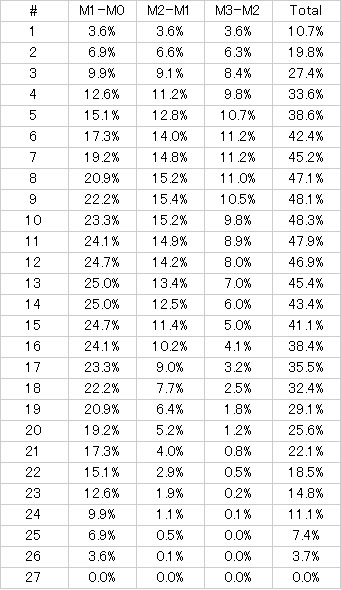
As a reminder, # is the number of desired cards in your deck, while M# is the amount of cards you’re mulliganing. For example, if there are nine cards you desire in your opening hand, then mulliganing two cards gives you a 15.4% greater chance of drawing at least one of them than if you mulligan just one card. Meanwhile, if you somehow have 20 cards you’d like to draw, mulliganing that third card isn’t very necessary - you’re only getting an extra 1.2% to draw what you want. The last column is the sum of the other three, or just M3-M0, to give you an idea of what the general marginal benefits are depending on how many early-game cards you want.
For those of you that like things presented visually:
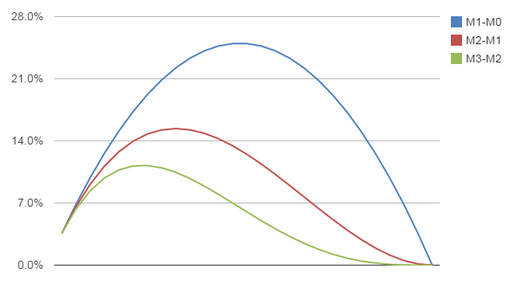
So it’s clear that you get the greatest marginal benefit from mulliganing one card over none if the number of cards you want is in the 13-14 range. Presumably, you’d be running Zoo or Hunter and you want your second 1- or 2-drop by turn 2 (unfortunately I don’t have the numbers for every situation, like getting a card by a certain turn including the mulligan). Meanwhile, if you’re looking for 8-10 cards, then comparatively speaking, you’re getting the most out of your mulligan if you toss two cards. Finally, when looking for 6-7 cards, you’re getting an extra 11.2% out of mulliganing that last card, greater than the marginal benefits for any other number of desired cards.
Here is the table and graph for going second:
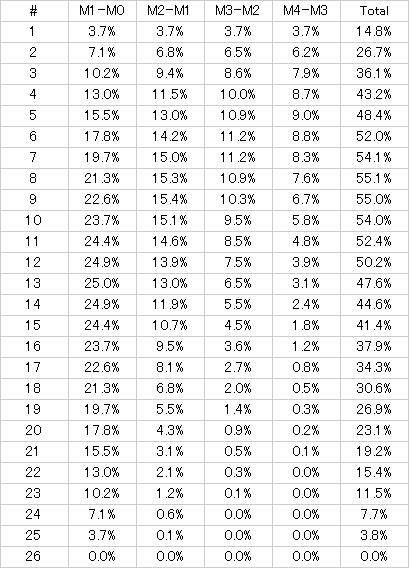
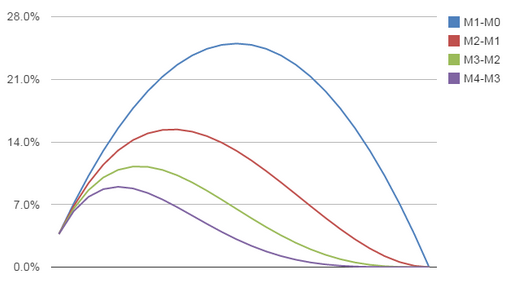
The percentages for the first three columns are pretty similar, while the fourth column shows that you’re getting the greatest marginal benefit from mulliganing your last card when you’re looking for five cards in your deck.
The most striking thing to me when looking at these tables is how much of a benefit there is to mulliganing one card over none, and two cards over one. In most cases, unless you have an absolutely perfect starting hand, you get a huge benefit from mulliganing one card. Therefore, playing it safe and keeping several cards for different occasions is probably not worth it if they’re not hugely impactful cards. You have to play the odds of needing certain cards against the likelihood of drawing into something better, the latter of which you now know.
The same is true for your second card - getting an extra 15% is still significant, so you need a very good reason to only mulligan one card. Keeping an extra card just because it might be good and you’re worried you’ll get back something worse is often just playing to lose. For example, let’s say you’re going first, and you have Acolyte of Pain, Shield Block, and Grommash Hellscream in your hand against a Hunter. The Acolyte and the Block are both vaguely good against Hunter, but keeping both “just in case” a specific situation arises will just be giving you great odds on a clunky early game. You’re going to have to pick between the two (though in this case tossing both would be reasonable as well).
On the other side of the spectrum, mulliganing your last card is often unnecessary. In particular, going second gives you a small marginal benefit on your fourth card, and you even have the coin to get to your safety card. So keeping a Truesilver Champion and dumping the rest, for instance, is fairly reasonable. As an aggro player, keeping one very good high-cost card and playing the odds that you’ll curve out anyway is sound strategy, since you might be getting only an extra 1-5% on that last card, depending on what your deck looks like.
Looking at my Druid deck from a couple weeks ago, the odds of getting a ramp card (six if you include Mech Warper) diminish the more cards you mulligan, so keeping a single safety card like Spider Tank to give you a reasonable start is likely correct. Of course, if you’re looking at a single card drastically affecting the odds of winning the game - Fiery War Axe versus Zoo immediately comes to mind - that extra six percent on your final card might be worth it.
Those are some of the situations and examples I could come up with regarding the mulligan numbers, what can you glean from them?