



Coming Soon Coming Soon Coming Soon Hire a Coach Watch Live Streams
404 Error - page not found
We're sorry, but the page you are looking for doesn't exist.
You can go to the homepage

OUR LATEST POSTS

Author: Nayn

When looking for a deck to use, whether for laddering or just for fun, there are two main routes you can take. First, you can “net-deck,” or copy a deck that someone else has created from the internet. From there, you can make some tweaks to it based on what you think strengthens the deck, particularly when taking the meta into consideration. However, you can also choose to pioneer your own deck. In this article, I will talk about the reasons to build your own deck, and explain how you should go about doing it.

Pros and Cons

You may be thinking: why build my own deck when I can use the best players’ decks? There is nothing wrong with this. It is reasonable to use the tried-and-true decks, especially for newer players who do not quite understand which cards are viable and which are not (“but the wisp has an infinite power-to-mana ratio!” is a common beginner misconception).

However, there are several upsides to using your own deck. First of all, doing well with a deck that you created feels very good and gives you confidence as a player. Next, as a net-deck becomes more popular in the meta, especially at higher ranks, people learn which cards are in the deck, and how to play around them. Using your own deck can catch opponents off guard and sometimes force them to play around cards that you don’t run. For example, if there is a Bloodlust Shaman deck at the top of the meta, and you are running your own late-game control shaman deck, your opponents may play extremely defensively, trading their minions and stalling until late game, where your control deck will actually have the advantage. Furthermore, people will even be running counter cards to meta decks. If your opponent is running The Black Knight to counter Ramp Druid, it will not be very effective against your Token Druid. Your opponent may even let The Black Knight sit in his hand, waiting for you to play an Ancient of War that you don’t have.

So if you have decided to try your hand at building a deck, read on to learn about the different types and archetypes of decks.

Deck Archetypes: Choosing an Outline

Many people acknowledge three basic deck archetypes: Aggro, Midrange, and Control. But first, I will take a moment to talk about two types of decks that I recognize before the three archetypes: Gimmick Decks and General Decks.

When people think about a Gimmick Deck, many associate the word with a negative connotation and believe that Gimmick Decks are the same as Cheese Decks and they are not viable. This is absolutely false; many of the best decks are Gimmick Decks. While most Cheese Decks employ a gimmick, a Gimmick Decks do not have to be cheesy.

A Gimmick Deck is simply a deck which completely revolves around a certain card or combo, without which it would be a totally different deck. Two popular examples of Gimmick Decks are Miracle Rogue, which revolves around Gadgetzhan Auctioneer, and Handlock, which revolves around the Warlock hero power in combination with Twilight Drake and Mountain Giant. These decks often do not fit easily into the typical Aggro, Control, and Midrange archetypes, and usually have a unique game plan.

On the other hand, although a General Deck can have important combinations, these decks do not really revolve around anything. These decks usually fit very well into the typical roles of Aggro, Midrange, and Control, and have a game plan of rushing, stalling, etc. based on their archetype. Two classic examples of General Decks are Control Warrior, which just aims to stay alive and tank damage until it can drop an endless number of late-game threats, and Face Hunter, which floods the board in the early stages of the game and kills the enemy hero as quickly as possible.

Deciding which classification your deck will fall under is the first choice you want to make. If a Gimmick Deck, you must choose what card or combo your deck revolves around. If you are making a General Deck, then you must also choose whether it is Aggro or Control, or, if neither of those, Midrange. You should still think about this even if you have a Gimmick Deck.

Choosing Your Cards

Now that you have an idea of your deck’s archetype, it’s time start building! For demonstration purposes, we will be creating a General Deck: Midrange Shaman.

If you are building a Gimmick Deck, your gimmick will obviously be one of the first cards to go into your deck. While choosing the rest of the important cards to go into your deck, there are several different categories you can consider, which we will review now.

Single-target removal:

Removal spells are a necessary part of every control and midrange deck, and they are generally included in most aggressive decks as well. Removal spells can help get rid of a minion when you don’t have enough damage on the board to deal with it, or when you just want to protect your other minions. Some removal spells, like Hex and Siphon Soul, work regardless of a minion’s health; others, like Wrath and Fireball, deal a set amount of damage. Removal spells often remove a minion with a higher mana cost than the spell; this is known as “trading up”.

The Shaman class has very strong removal. Although we could have added more removal than we did, it is important to remember not to have too much removal in a deck. Too much removal will clog up your hand and force you into being more reactive than proactive.

Rockbiter Weapon, Lightning Bolt, and Hex are all strong removal spells that will fill an important role in our deck. They each have their upsides and downsides, but all make a strong case for inclusion.


Area of effect removal:

Area of effect removal (AoE) is incredibly valuable for midrange and control decks, providing incredible efficiency against more aggressive archetypes. It has the potential to wipe out your opponent’s board, trading several of your opponent’s cards for one card and giving you card advantage. However, AoE should be kept to only one or two individual cards, as it is practically useless when your opponent has a small or consolidated board.

Lightning Storm is the Shaman class’s only AoE spell, but it is a very strong one. For a 2 mana overload drawback, it is much stronger than its 3 mana cost. It also has the potential to “roll high” on a minion, dealing an extra point of damage.

Card draw:

With 30 cards in a deck, sometimes it can be tough to draw into your threats and answers. Card draw is an invaluable factor in every deck, allowing you to continue to play cards and not run out of steam as the game progresses.

Unfortunately, the Shaman class suffers from poor card draw compared to other classes like Warlock and Druid. We will try to make up for this with neutral card draw; adding in 2 Azure Drakes, 1 Bloodmage Thalnos, and 1 Mana Tide Totem. Azure Drake and Bloodmage Thalnos both give spell damage, which goes well with our removal spells. We only use 1 Mana Tide Totem as it is slower than most card draw effects, and it also evens out our deck since we can only put in 1 Bloodmage Thalnos.


Tech cards:

Tech cards are cards that will do well against the current metagame. These can often be swapped out as the meta changes and they become more or less useful. Understanding the meta is an important part of deckbuilding, and it is necessary to remove once-useful cards that are now dead in your deck.

The meta is extremely diverse right now, making it very difficult to choose the right tech cards. However, I think The Black Knight will be very useful in our deck with the ubiquity of Sludge Belcher on the ladder. Since aggressive decks like Zoo Warlock and Face Hunter are very popular right now, we will add in Sludge Belchers and Harvest Golems that will stick to the board and trade with smaller creatures. Finally, we will add in two Earth Shocks, as silence is also very useful against Zoo Warlock and Face Hunter, which utilize small deathrattle minions.

Finishers and win conditions:

Although slower decks can slowly accumulate an advantage, they benefit greatly from a way to close out games. Finishers are generally combinations that provide high damage in one turn. Win conditions include cards that simply provide so much value that, if left unchecked, they create an insurmountable gap between you and your opponent. Finishers are generally less useful in aggressive decks, who already deal enough damage and cannot afford to have cards sitting in their hand.

For our finisher, we will use 1 Bloodlust. Its downside is that it requires you to have a large board, but the Shaman class arguably does this the best with its hero power. Bloodlust can pump out an incredible amount of damage for only 5 mana, and it only costs 1 card, so you do not have to accumulate a multi-card combo. We will only use 1 because it is all but useless when you are behind, so having 2 Bloodlusts clogging up your hand can be a real hindrance.

For our win condition, we will use two Stormwind Champions. This is a very interesting card that is not seen very often, but it has a lot of synergy with the Shaman class. When played, it will essentially transform all of your totems into 2-mana cards that can trade for your opponent’s larger cards in a “zerg rush” style. Stormwind Champion is best used when you can get value from him on the turn he is played. For example when you and your opponent are even on the board, suddenly your minions will be able to kill your opponent’s and remain alive with a bit of health, allowing them to trade 2-for-1.

Since both of these cards benefit from having a large board, our game plan is now apparent. We will attempt to flood the board (don’t forget to play around AoE) with, utilizing spell damage paired with efficient removal to keep our opponent’s minions from contesting ours. Finally, we win the game by utilizing Stormwind Champion to hopelessly outvalue our enemy, and end the game with a massive Bloodlust.


Mastering Your Mana Curve

One of the most important parts of a deck is its mana curve. This attempts to ensure that we will have a reasonable play on every turn (although turn one is usually less important for non-aggro decks). When deciding on the last cards to go into your deck, try to take minions of varying costs so that you always will be able to have a strong minion to play. For extreme aggro decks, try to make sure you have several strong minions costing between 1 and 3 mana. For midrange and control decks, try to ensure that you have solid plays from turns 2 to 6. However, control decks will usually forgo some of those plays in exchange for several very expensive (7+ mana) game-changing cards.

Looking at our deck, we are lacking strong, non-situational minions to play on turns 2, 4, and 6. We only have one strong play on turn 3 as well. With this in mind, we will add two of the following cards to our deck:

Feral Spirits is a very strong turn 3 play that completely stops aggro decks in their tracks. However, be aware that its 2 mana overload means that, when played on turn 3, it will only leave you with 2 mana to spend next turn.

Flametongue Totem, while rarely a minion to play on turn 2, is a great follow-up play to Feral Spirits. It also allows your smaller minions to trade up for your opponent’s larger minions.

Haunted Creeper is a solid minion to play on turn 2 that is very difficult to remove. Its stickiness synergizes very well with Bloodlust and Flametongue Totem.

Chillwind Yeti is arguably the most reliable minion to play on turn 4. Its 5 health makes it very tough to remove, and its 4 attack means that it can take out 4/4 bodies such as Azure Drake, Gadgetzan Auctioneer, and Dark Iron Dwarf while still living to trade for another minion.

Fire Elemental is an extremely strong minion, taking out a smaller creature with 3 health while providing a threatening 6/5 body of its own. It is rarely ever less than a 2-for-1 trade.

Conclusion

So there we have our completed Midrange Shaman deck! Feel free to try it out for yourself if you’d like; I tried to keep it relatively cheap to craft (and you can always swap out Bloodmage Thalnos for a Loot Hoarder). Most importantly, I hope you learned some of the important considerations to have when building your own deck. Deck-building is an artful process that requires experience to master, but you should never be afraid to try.

Have any of your own tips for creating a deck? Feel free to share them in the comments section below. Good luck on the ladder, and happy building!
Author: Joseph Scalise

Introduction

In this week’s deck write up we are bringing back an old favorite: Token Druid. While normally I write about decks that I have built, today I’m actually going to a feature a deck that a friend of mine (BattleBurned) took to legend, and it’s a deck I have been playing with towards the top of the ranks. It is, like last weeks, another Druid deck that uses the combo to fight against the ever shifting meta, but this one goes about that plan a little differently.

Token Druid is a deck that has always been about building a strong board of resilient minions. Each card is built towards ending with the combo and allowing you to keep board control through cheap, effective minions. This version of the deck takes the traditional old token deck with combos like Violet Teacher and Power of the Wild and mixes it with the new Kolento style deck with things like Haunted Creeper and Echoing Ooze. It works really well, and is a great silver bullet for fighting back against a Hunter heavy metagame.

Key Cards

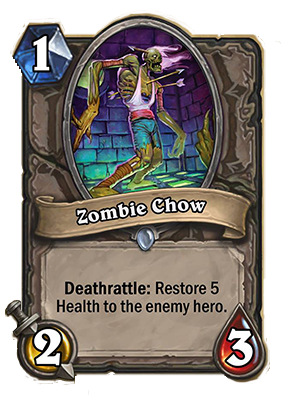
Zombie_ChowZombie Chow

Zombie Chow in an aggro/combo deck? Yes. So much yes. When discussing the deck with BattleBurned I was really suspicious of the chow, but it is extremely important in the current meta. This card on turn one is a key play in the aggro matchups (which take up a good portion of the ladder), and will single handedly swing games. It is not simply that this card can win a fight with most early minions, but that it allows you a turn or two before your more resilient, stronger minions can be put on board. One big aspect of this deck is board control, and no card controls the early game better than Zombie Chow. Always try and mulligan for this card in every matchup and never mulligan it away.

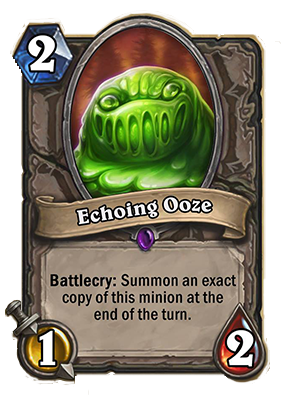
Echoing_OozeEchoing Ooze

Oozing out of the walls is a very interesting two drop. Echoing Ooze was a key card in Kolento’s token builds, but this card works much differently in this deck. Echoing Ooze is primarily a card that functions with the help of something else, be it a Mark of the Wild or a Defender of Argus. However, in this deck, because the only real buff for it is Power of the Wild (which works just as well after the Ooze has been played) it is just two one/twos for two, and that’s just fine. Token is a deck that gains board control and victories through sheer number of minions, and ooze fits right into that plan. I primarily will run this out on turn two as a way to represent two distinct threats. Sure, it’s not the heaviest beater, but it works so well with Savage Roar and Power of the Wild that the card is a must have.

Soul of the Forest

Probably the strangest card in the thirty, Soul of the Forest is a wonderful silver bullet that makes unwinnable games suddenly winnable. This card has many downsides; needing minions to be good, needing a lot of minions to be good, and costing four mana. These are reasons you would never want two. However, a well timed Soul of the Forest can also bring you back into games and make combat math miserable for Control or Midrange decks. Obviously this card should never be kept in when mulliganing, but if you curve right into this card after spamming cheap minions (especially creeper and golem) you can set up a Savage Roar win by turn six or so. Not only that, but there are many decks that have real trouble handling a board that can replace itself with a bunch of two/two trees (Warrior).

Violet Teacher

Pay attention class! Violet Teacher was an old token favorite (as many of you know) that really fell out of favor during the rise of Naxx. I am largely unsure why this happened, but in a deck that wants to spam creatures to build board control no one does it better. There’s not too much to say, but I wanted to talk about her because she is a must have in this build. Because of the nature of this deck you can get board control early and then save teacher/power to come back just in case of a Lightning Storm or the like. This is her strongest attribute and best use. Also, if you lack an early game she can quickly let you take over the board when comboed with Innervate and other cheap spells.

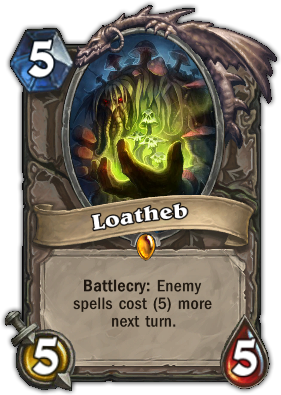
LoathebLoatheb

It seems that I discuss the possibilities for Loatheb in ever article I write, but he’s just so good. He gets even better when worked into combo decks like this one. The reason is, you want to do whatever you can to keep board control. Loatheb makes it so your plans will almost always go unfettered. If you want to set up a Force of Nature/Savage Roar play on turn nine (or some other turn) playing this card before hand is the best way. While there are a lot of problem minions in the game, your Savage Roar plans (and board) are almost always interrupt by powerful spells. Placing a 5/5 onto the board that can also disrupt those spells is a great way to cement wins. Loatheb is just also a fantastic play when you already have board control to keep you in a position to win.

How to Mulligan

Due to the way the metagame (and this deck) is built, mulliganing never really changes. You always want to look for early minions to play, and then hope to draw into spells to back them up. Zombie Chow, Haunted Creeper and Echoing Ooze are how you always want to start the game, and you should mulligan away everything else that isn’t an Innervate. Innervate is always a must keep in Druid, and if you have it you should try and look for either a teacher (to play turn one or two) or a Harvest Golem.

When playing against an aggro deck (Hunter or Warlock) I find it a good idea to always keep Swipe and look aggressively for Wrath. Swipe may seem slow, but if you have access to some strong early turn plays, Swipe can really help you cement board control. Swipe is especially strong against aggro as it kill off all three Animal Companions and does away with both Dark Iron Dwarf and Nerubians. This is very important. Sometimes If I have the coin I will also keep Keeper of the Grove against Warlock due to the versatility of being strong against both Handlock and Zoo. The only other part of mulliganing is to get rid of Harvest Golem unless you have a turn two play or you have the Coin. I know that sounds strange, but you usually want to start a lot faster than turn three. Always keep Harvest Golem if you have the Coin.

How to Play

While this deck is an aggro deck, it is an aggro deck in the same way that Zoo is an aggro deck. It’s all about board control. There are two of the combo in this deck, and you should always remember that. The combo is your ace in the hole, and always give you an out to suddenly win a game. You want to try and start the game with small, efficient minions and then build up from there. Zombie Chow, a two drop into Harvest Golem into Swipe is a great curve, and the type of opening you want to have. This deck is always trying to get your opponent to fourteen by turn nine, but a curve is just as important. Unlike many other aggro decks, this deck has the ability to explode ahead through Innervate and also has the ability to scale into stronger creatures. Sludge Belcher, Ancient of Lore and Violet Teacher are your heavy hitters, and will allow you to match up with stronger decks as the game goes on. Start low and end fast with this deck and you can pile up the wins.

Matchups

warlockZoo

One of the prime reasons to play this deck, Zoo is a great matchup that is always in your favor. Zoo has always had trouble with hard to remove minions, and since you can spam the board backed up with removal they usually can’t keep up. Harvest Golem, Echoing Ooze and Haunted Creeper are all very hard for Zoo to deal with, and Keeper of the Grove is yet another tool that can silence eggs and kill of Knife Jugglers. As always, if you Innervate out something early you will almost always win, and once you have board control you will almost never lose it. Swipe is an all star here, and the only card you need to be wary of is Doomguard, which should be dealt with at all costs.

warlockHandlock

Unlike Zoo, Handlock is a very tricky matchup to navigate through. However, it is also quite winnable. A turn four giant can be an absolute nightmare, but a Drake is usually doable. This is a matchup you are only going to win off of Savage Roar, which is in your favor. The reason for this is that roar allows you to always keep them at higher life, which takes away their potential for Molten Giants. In addition, Keeper and Swipe are also great tools for finishing off a Handlock that has put down to very low life. For this reason, if I do have close to lethal and one of the aforementioned cards in my hand, I will usually try to knock their health down before they have a chance to play taunts. Start early and fast here, as one of the only ways to stop a turn four giant is through running all or most of your minions headfirst into its eight health.

shamanShaman

Besides Hunter, I would say that Shaman is the most popular deck these days on the ladder. Whether that is due to a genuine interest in the deck or botting I do not know, but either way this is a class you are bound to encounter. Shaman is a fifty/fifty matchup that really comes down to the first two turns of the game. It may seem strange to simplify the matchup like that, but the truth is if you get started early they can’t come back, and vise versa. Their removal is great at answering every minion we have access to. Earthshock and lightning bolts are all-stars for them, and Hex can answer everything that comes after. However, if they lack early game removal it is really hard to lose as you will usually be able to play minions without resistance. Feral Spirit is annoying, but a strong board (and Wrath) can answer the wolves just fine. In addition, Loatheb will help keep things rolling along or merely end a game on his own.

The main rule in the Shaman matchup is to never let them have minions of any kind. Always kill spell power totems (for Lightning Storm purposes) and clear out anything else to play around Defender of Argus. They have no healing, so all damage you do sticks, which makes the savage/force combo even better. Violet teacher is a great way to rebound after a board wipe, and as such I will almost always save Power of the Wild in this match unless I need to put pressure on.

warriorControl Warrior

BattleBurned claims this matchup is the hardest there is, but I have had great success against the armored menace (currently 6-1). It seems that unless they have an early Armorsmith, there isn’t a lot they can do to fight back against most of your cards. Keeper of the Grove is really strong with coin, but it’s usually two slow if you’re going first. However, being able to shut off Armorsmiths, Acolyte of Pains and Sludge Belchers are all really important. Warrior only runs two taunts in the form of Sludge Belcher, and if you can get through that they are really weak to the combo.

hunterHunter

Another ladder menace, Hunter, while not favorable, is around a fifty/fifty split. You can’t really ask for a better win rate against Hunter, and as such this deck delivers. Just with Zoo, Harvest Golem, Haunted Creeper and your removal give them a lot of early game trouble. Zombie Chow is also fantastic here, and the savage/force combo usually will always finish the job. The tricky part is playing around Freezing Trap and staying alive long enough to combo kill them. The best advice for this matchup is to always assume every trap is freezing, and play around it accordingly. The reason for this is, Freezing Trap can really swing a game if it hits a Harvest Golem or some other slow minion.

The rule of Hunter is to stay alive, and the best way to fight them is to always be one step ahead. Always be aware of what they can play and what they haven’t played. For instance, know that their turn two is almost always going to be either Mad Scientist or Haunted Creeper and plan for that by coining out an early golem or holding back Wrath. Also, Swipe is your best (and only) answer to Animal Companion so know that. It also is a great way to deal with Snake Trap. The last note is to remember that Unleash the Hounds is finding its way back into the meta. Spamming creature is key, but don’t get blown out at the wrong time.

priestPriest (Deathrattle/Control)

Every deck has a nightmare matchup and Priest is this decks. You just don’t want to play Priest, and there are many, many reasons for that. One, they can come out of the gates better than you can, and also have a fantastic board reset in Auchenai/circle. Holy Nova is great against us, as is Shadow Madness, Cabal Shadow Priest and Sludge Belcher. If they slip up and play nothing the first few turns a combo kill may be possible, but for the most part they have all the answers to all of our questions. Ancient of Lore is very good for the later stages of the game, and Soul of the Forest can be very good, but since you need to start fast you can never really afford to keep either of them. I will usually keep Swipe in this matchup as a way to fight back against Dark Cultist, another problem card that can ruin a strong start.

Budgets

This is a very cheap deck that only runs one free legend. All of the cards are in place, and there isn’t anything to change. Just a solid, fun to play, cheap deck. I hope you enjoyed this week’s deck tech, and I hope that you enjoy the deck. As always, thanks for reading, and until next time, may you always roar your way to victory.

Team DKMR: Twitter | Website

Sponsored by: Gunnar | 2P.com | Waypoint Media

Hunter takes the top of the ladder this week with Warlock close on its heels. The other two Undertaker classes, Shaman and Priest, follow closely behind.

Here’s Team DKMR’s weekly Meta ranking. Keep in mind, it’s about which classes and archetypes are played the most, not about which are the strongest. Most of the time, the strongest decks will also be the most frequently played, but that’s not always the case. That’s just part of how the Meta works.

hunterHunter: Hunter has retaken the ladder this week. Aggressive midrange Hunter decks have been the go-to for many ladder players recently. The deck wins quickly and has generally favorable match-ups, making it a force to be reckoned with on the ladder. Many current builds are running some combination of Unleash the Hounds and Snake Juggler. Such builds often use Knife Juggler where they once had Starving Buzzard. Several midrange builds are packing a Dire Wolf Alpha or a pair of Sludge Belchers to improve trades in the mirror.

warlockWarlock: Warlock remains an incredibly popular deck on the ladder. Zoo will likely always be a top choice for newer players, being inexpensive and easy to learn. Despite Hunter’s popularity, Handlock is still a strong deck as well. Its draw engine, removal suite, and threats are significantly stronger and faster than many of the slower decks currently popular.

shamanShaman: Bots, bots, everywhere! While many of your Shaman opponents may be Sea Giant bot masterminds, there are still quite a few true blue human Shamans out there. The deck is one of the few control decks that can effectively utilize Undertaker, making it a fast deck with a flexible suite of removal.

priestPriest: Priest has retained its popularity largely due to its excellent match-ups against many of the game’s most popular decks. Zombie Chow, Auchenai Soulpriest, and Cabal Shadow Priest make the Shaman match-up a breeze and help a lot in the Hunter and Zoo match-ups as well. The Priest’s Hero Power also allows it to play the long game versus control.

druidDruid: Druid remains a popular, proactive deck choice on the ladder. Nearly every Druid you run into on the ladder will be the “fast” Druid playing double Force of Nature combo. Some builds have also replaced Haunted Creepers with Sunfury Protectors to taunt untargetable Spectral Knights.

mageMage: Most Mage builds on the ladder currently are midrange builds based on Duplicate and Deathrattle minions. Freeze Mage is also reasonably popular, but suffers from its poor Hunter match-up. It does have a strong Warlock match-up though, so give it a whirl if you’re looking to overcome Zoo!

rogueRogue: Variants of Miracle Rogue have remained reasonably popular. Most builds have moved to more minion oriented builds including Violet Teachers and Shade of Naxxramas.


warriorWarrior: Warrior continues to take high places on the Legend ladder, but is not
particularly popular. It has a strong Hunter match-up, but suffers against Zoo. Not only that, but games with the deck tend to take longer than nearly any other.


paladinPaladin: Control Paladin continues to see mild play on the ladder, but has predominately fallen out of favor. Aggro Paladin has also failed to find a reasonable build as of late.


Deck of the Week: Freeze Mage

Freeze Mage saw a resurgence at the NA Qualifiers in the hands of Hyped. The deck has a strong Zoo and Handlock match-up. With a poor Hunter match-up, it can be a difficult deck to play on the ladder. However, it’s an excellent deck to play in tournaments, particularly those where you can ban Hunter or Warrior.


KendricSwissh On - Twitter | Twitch.TV | Youtube | Facebook

Hearthstone’s Meta is part of an ever-changing process. Millions of people are enjoying the game on a daily basis and have thus become more and more skilled at playing it. In his latest video KendricSwissh would like to demonstrate how “old” cards that have been falling under the radar can suddenly make a shining comeback thanks to a change in the Meta. Are there any cards you have reintroduced to your own decks lately? Feel free to discuss and share your stories in the comments!

Author: Joseph Scalise

1. Introduction

Man has it been a tough two weeks. I’ll say that much. The ladder has been all over the place, which is a double edged sword. On one hand, it’s nice that there is a diversity of decks out there. On the other hand this metagame is a tricky one to pin down. Some days I’m fighting through hordes of Hunters and Zoo, and others it’s all Priest, Handlock and Shaman. Ever hero has a chance right now, which has been great for everything except my ladder climbing. Well, that was until I built this deck. Before this deck I was sitting in the purgatory that was rank 10/9. Now, I’m back in the upper ranks and, more importantly, I’m having fun doing it.

This deck came first about when I got crushed by a Ramp Druid. I didn’t get beat. I didn’t get outplayed. I got crushed. He had a perfect curve, ramping into Loatheb, Cairne, Ancient of Lore and the Force of Nature/Savage Roar combo. I was upset, but it got me thinking. It is a rule of trading card games that when a metagame is in turmoil (like this one) you need to find a constant. What that means is that you need something that is good against all decks. For me, that is the Force of Nature/Savage Roar combo. Everything in this deck is about that combo, with each card building to an eventual Savage Roar win.

2. Key Cards

A lot of the cards in this deck are routine Ramp Druid cards. I won’t be covering those cards in depth, but there are some key cards that cannot be cut which I will explain in further detail below.

Wrath

When playing Warrior early in the season I said one of the reasons I liked the class so much was due to the fact that Fiery War Axe was a great answer to Undertaker. In this meta you absolutely need an answer to Undertaker, and this deck’s answer is Wrath. To be honest I didn’t even want the card in the original list, but if you don’t have a strong ramp opening you need this card to stay in the game. Wrath is very versatile, which is why it has always been an auto include in Druid, and the card draw mixed with a way to take out Undertaker is necessary.

Harvest Golem

Harvest Golem is a card that found its way out of Ramp Decks (or Druid decks in general) but it is essential in the current meta. Hunter and Zoo are everywhere on the ladder, and both have a hard time with the Golem. It trades early, sticks around and has the token aspect of being able to hang around for the combo. Running two is an absolute must in this deck for both the early and late game purposes. Watch out for Priests, as they love to take these with Cabal Shadow Priest, but mulligan for this card against every class. Play them early and play them often.

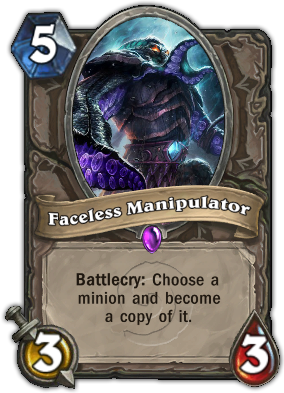
facelessmanipulatorFaceless Manipulator

This card may seem like a strange choice in this deck (especially as it takes a slot over a second Azure Drake or Spectral Knight) but like Harvest Golem I think this card is an essential tool. There are many merits in running another card in replacement for the manipulator, but I wouldn’t. The reason for this is, while this is the only card in the deck that doesn’t set up the combo, it is good against most decks. Like the force/savage combo, Faceless Manipulator is a card that comes in handy time and time again. Going in cold against a diverse meta you want versatility, and no card has more versatility than this card. He also is very good at giving you another Spectral Knight or Cairne to help make your combo just that much stronger.

LoathebLoatheb

In terms of setting up the combo, no one does it better than Loatheb. Every card in this deck serves one of three purposes: disruption, resilience or card draw. No card in this deck does disruption better than Loatheb. He is great when Innervated out early, because he’s impossible to remove and will help you control the board until your big threats come out. He is also good on turn five or six when you need to regain board control. However, his main purpose is to be played the turn before you want to Force of Nature/Savage Roar. The reason this deck works is because you are almost going to use the combo with a big creature on board (ramping up the damage potential) and Loatheb is a minion that will always be around.

Cairne Bloodhoof

How the mighty have fallen. Cairne was once the Druid staple. A midrange card that terrorized the meta and made control decks quiver in fear. However, Sap, Freezing Trap and an aggressive meta made him just too slow. Now that the gears are shifting and midrange decks are back, he once again has his time to shine. There’s not too much to say about Cairne that hasn’t already been said. He’s as good as he’s ever been, and is great

when you can combo him with Faceless Manipulator. He’s great against control, can give aggro nightmares if Innervated early enough, and keeps a creature on the board for the combo. He’s mostly in this deck as yet another way to keep something on the board for the end of the game.

Frost Elemental

I know what you’re thinking, Frost Elemental? Yes. Really. This card is not only an essential card to this deck, but it is the one card that made my ladder climb possible. This card acts just like Loatheb, locking down your opponent to give you either board control or a way to set up the combo, but it shuts down minions instead of spells. What’s important about arena all star Frost Elemental is that, not only does it keep your opponent’s minions from being able to respond to it, but it also protects your other minions from taking damage the next turn. In this way it sets up the combo perfectly, because it allows that extra minion to stay alive, dealing the extra six or so damage you need to win. The combo does fourteen damage, but this deck is trying to do twenty plus damage in one swing. Frost Elemental makes that happen.

Ancient of War

Although this card may have more of a purpose in a traditional Ramp Deck, Ancient of War is in this list because of its resilience. Yes, it can be a nightmare for aggro decks to deal with, but it’s mainly here because ten health is very hard to remove. This deck creates pressure through a large diversity of threats, and Ancient of War is your juggernaut. You can play this soon to bait out your opponents removal, but a lot of the time I will wait until I have exhausted my opponent’s resources before dropping this ancient. You can play it either way, but always, always be on the look out for The Black Knight.

3. How to Mulligan

Mulliganing in this deck is pretty straight forward. As this deck is built as a way to combat all classes there is no special way to fight against separate classes. What that means is, mulligans are always the same for each class. The strategy is simple here: mulligan away anything that isn’t an Innervate, Harvest Golem, Wild Growth or Wrath. Seriously. You are always looking for those four cards. Those are the catalyst of this deck, and each one is needed to keep you in the early game or prevent you from falling behind.

The only time your mulligan strategy changes is when you either have a Wild Growth or Innervate in your first hand. In this case, you want to keep midrange threats in order to power them out early. Any five drop is fine to keep with Innervate, but you should still get rid of six or seven drops. When I have an early Innervate or Wild Growth I will also mulligan my other cards aggressively in hopes of finding a Keeper of the Grove. That card is a perfect answer to an early Undertaker, Mad Scientist or Northshire Cleric and should always be brought out as early as possible

4. How to Play

I’m sure this has been hammered home by now, but it’s all about the combo. I stated this earlier, but every minion in this deck is either about resilience, disruption or card draw. The reason this deck is so strong isn’t that it has the ability to combo, but rather than it has the ability to combo with other minions. Fourteen damage is nice, but you are shooting for the stars here. Often this deck hits twenty plus damage, and every minion makes sure that happens. Like all Druid decks, board control is the most important aspect here. Make sure that you always clear your opponents minions when you can. Use Loatheb and Frost Elemental to lock down the board when you can, and always be aware of how much damage potential you have.

There are two Savage Roar and two Force of Nature in this deck. That’s important to remember because you can use one of those cards early (for damage or removal) and still have hopes of drawing into them later. While you want to have the whole combo, because you almost always have minions on the board, many games are won on the back of Savage Roar. This card comes in handy time and time again, and you can easily set up wins without the trees to go with it. If you start ramping early this deck works very well, but above anything else, make sure you keep your minions alive. There are plenty of ways to do this, and each one should be utilized to it’s best effect. Never play a card just to play it (The Black Knight) unless you have a sure fire kill the following turn.

5. Matchups

hunterHunter

Get ready folks, this class isn’t going away any time soon. You need an early game here otherwise you will get run over. Innervated or Wild Growth’d keepers are very important, shutting down Mad Scientists, Undertaker and Haunted Creeper. Wrath and Harvest Golem are also very key. While this match is one of the toughest (due to the fact that their hero power can get around taunts) it is by no means unwinnable. I would say it is about fifty/fifty, with most of the games coming down to if you can combo before their hero power knocks you out. You will almost always have board control after turn six, but unfortunately sometimes that’s not enough.

The most important thing to note is never attack a big taunter into a potential Freezing Trap. Even if its the only minion you have, don’t risk it. Let them run their minions into yours until you can check it with something that will benefit from it like Loatheb, Frost Elemental or Ancient of Lore. Also, don’t forget that Frost Elemental can shut down an attack from an Eaglehorn Bow in a tight pinch.

warlockZoo

Zoo is a menace that also happens to be the easiest matchup for this deck. We have so much access to taunt, removal and silence that any form of acceleration usually just shuts them down. If you can get any type of momentum it is very hard for Zoo to come back. Remember, while setting up the combo might be tempting here (especially because of their habit to life tap) you want to always keep their board clear. Zoo thrives off of minions, and if they don’t have any they can’t really formulate a strong gameplan.

warlockHandlock

Another pretty easy matchup, Handlock only really gives us trouble if they have a Mountain Giant before we can establish a strong board. You are always going to win with the combo, so Molten Giants aren’t usually a concern. The Black Knight is very important here, as are Sludge Belchers and the like. You will most likely be able to get them in range pretty easily, and both Loatheb and Frost Elemental shine in keeping the few threats they do have in check. The only thing you need to be aware of here is their ability to heal with an Earther Ring Fareseer or Siphon Soul.

warriorControl Warrior

A deck that will always be strong, Control Warrior is a tough matchup for several reasons. One, they have a lot of armor, which can be tricky when trying to set up a one turn kill, and two, they have ways of removing everything. In this matchup you are a straight ramp player, forcing them to deal with your threats as you lay them on the board. While it might be tempting to accelerate into the combo, often that plan can get spoiled too easily by something as simple as an Execute of Shield Block. They have many types of removal in addition to a plethora of annoying creatures. The way you win this match is through the combo, but usually only after you have exhausted all of their resources. Your advantage in this matchup is large minions, so play them early and play them often.

shamanShaman (Midrange)

With Sea Giants slowly phasing out of Shaman decks, the midrange deck is becoming more and more the norm. This matchup is a straight up clash of power, big creatures fighting back against big removal. They, much like Warrior, have ways of clearing everything you play. However, they have the advantage of being able to do so while also silencing in the process. This is very tricky, and can be a hard matchup if you fall behind. Loatheb could not be a better turn eight play to set up the combo on turn nine. He also is amazing in the mid-game if you have control of the board.

This match is all about board control, and one of the distinct advantages we have is that Fire Elemental is generally a weak play against all of our big minions. Not only that, but if you force Shaman to overload early while ramping into threats they almost can never come back. One last thing to mention is that they can never heal, so what life they’re at is what they get. As such, there are many times where I will use a Savage Roar early on in the game as a way to put them at low health so I can more easily finish them off later.

priestDeathrattle/Control Priest

Priest is another matchup that almost always falls in our favor. A little ramp goes a long way here, as most of our mid-range threats are very good against Priest. They find strength in their answers, but cards like Spectral Knight, Sludge Belcher and Cairne make most of their removal useless. They can start off very fast, with turn one combos such as Undertaker/Zombie Chow, but those combos are also weak to Keeper of the Grove and can’t punch through a belcher. The two cards you always need to be aware of are Cabal Shadow Priest and Auchenai/Circle, which are both really good at clearing the board. If you manage to keep their minions in check, much like Zoo, they usually will not be able to build up enough momentum to survive a combo hit.

6. Budget Replacements

This is a rather expensive deck that, unfortunately, doesn’t have any strong replacements. Every card has it’s purpose, and most of them are key to the gameplan. All four ancients are very necessary in balancing between card draw and late game potential, and this deck should not be played without them. Cairne is very essential, giving you a resilient minion that also does a good amount of damage. If you absolutely need a replacement for him I would run another Spectral Knight, although it’s not quite the same.

The last (non-free) legend in the deck is The Black Knight. Normally, I would suggest a silencer as a replacement for the six drop. However, this time around The Black Knight isn’t here to clear taunts to set up the combo (although that’s an added bonus). Rather, he’s just here for board control more than anything else. Getting a four/five in exchange for removing an opponent’s minion is huge and the kind of interaction this deck thrives on. You could try to run a Spellbreaker in his place, but that won’t get you the same kind of result.

Well, that’s the deck. I’m very excited about it, and fully plan on taking it to legend in the coming week. As always, thanks for reading guys. Until next time, may your Innervates come early, and come often.

itunes rss feed
mp3 download

On Today’s episode Hosts Frodan goes solo as Gnimsh is away and brings on DTwo and Firebat to talk about the metagame, tournaments and a whole lot more!

NA - Road to Blizzcon
News: www.gosugamers.net/hearthstone/news/28669-roadtoblizzcon-europe-day-two-full-recap-with-vods-and-thefishou-s-aggro-mage

Decklists: www.gosugamers.net/hearthstone/news/28745-three-winning-decks-from-blizzcon-na-day-one

Topics:
First live tournament experience
Preparation style: Why bring the classes you did?
Firebat disconnect win
Other 2 qualified players: StrifeCro, Tarei
Fun behind the scenes moments or cool stories?

Other NA finalist decks + Metagame discussion

Topics:
Decklist breakdown: Hyped’s mage, Chakki’s Doomhammers, Tarei’s Miracle
Undertaker needs a nerf? www.twitter.com/bdbrode/status/519350289657511936

WCA in review
Bracket: www.gosugamers.net/hearthstone/news/28735-zoo-fest-ends-wca-2014-as-libo-takes-the-97-000

Topics:
WCA was quite the mess, but is there anything worth taking from it?
Thoughts on the Chinese players vs Western players
People hating on Zoo — justified?

DH Bucharest announced
www.liquidhearth.com/forum/hearthstone-tournaments/468681-nescaf%C3%A9-3in1-hs-dreamhack-masters-bucharest

Topics:
Initial details: $10,000; RDU, Gaara, Ekop, Lothar, Frezzar; same time as BlizzCon pre-event
Possibly harder than BlizzCon event itself?

Viagame House Cup and Competitive Format Discussion
www.gosugamers.net/hearthstone/events/247-viagame-house-cup

Topics:
Thoughts on format?
Any predictions
Format discussion: What has been the best so far in HS? Do you think another format is viable?

The rest of October…

SeatStory Cup 2 Hype!
www.taketv.net/news/-30-09-14-21240

Gamers Origin October 25/26th
www.liquidhearth.com/forum/hearthstone/467089-gamersorigin-cup-2-by-ogaming-tv-and-gamersorigin

Blizzcon Schedule is out
www.us.battle.net/blizzcon/en/event-info/schedule/friday

Reynad game LOL!
www.vimeo.com/107964619

https://www.reddit.com/r/hearthstone/comments/2i8dua/i_made_a_game_ft_reynad/