








Face Hunting for Fun and Profit

Author - Mike Tyminski On: Twitter
A couple of weeks ago I was playing some games on the ladder using a Paladin midrange deck I had built to stuff Zoo (it was the first week of the season, so selling out to Zoo felt like a priority) when I received a shock unlike that I ever had before. Over a couple of games I started hemorrhaging stars to such world beating boards as Stonetusk Boar and Ironbeak Owl, often without the slightest hint of the Unleash the Hounds style all-in combo that had been the rage just a few weeks prior.
So needless to say, I was entranced at the fact that I was putting up a goose egg against some cards that would feel questionable at best in most situations. So I mocked up ThijsNL’s list from King of the Hill #25 (list below, but click the link to see the deck in action) and took it out for a spin to get a better read on the deck itself. (Decklist to the right)
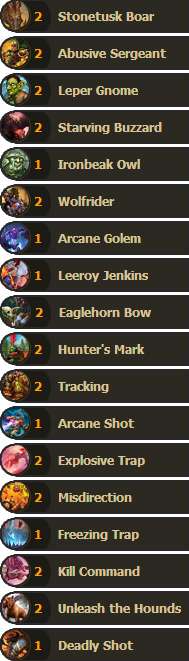
So what takeaways can we get straight off the bat? First and foremost, this list is super aggressive, only breaking the four mana barrier for Leeroy Jenkins. Most of the minions in the list have charge, and the ones that don’t either deal damage on death (Leper Gnome), have psuedo-charge by buffing another minion (Abusive Sergeant)or are going to give immediate impact when paired with Unleash the Hounds or count for Kill Command (Starving Buzzard).
It’s also the sort of deck that wins solely on the back of counting to 30. Pretty much every trade needs to be considered in terms of damage. If using a hunter’s mark and a arcane shot on a shieldbearer allows you to push through six damage, then that’s more often than not the play you’re going to make, even if it’s counter intuitive from a card advantage perspective.
Playing the deck, you’ll find that you typically want to lean a lot on your hero power. A line of play like Leper Gnome, Steady Shot, Steady Shot plus 1-Drop is pretty common and often can leave your opponent around 20 by turn 4. A lot of the time you find that your hero power can do in the ballpark of 8 to 14 damage in the course of a game (not shabby for a hero power that many have derided as the worst in the game, huh?). Similarly, I would recommend not over-prioritizing your Unleash the Hounds combos as this particular build doesn’t play many of the support cards that truly make the card as bursty as it can be (for example, there are zero Timber Wolves in this list).
Pros and Cons:
Pros:
First and foremost this deck is absurdly simple to play, since every play is built around maximizing the amount of damage an opponent is going to take in a given turn. The deck is also incredibly cheap in terms of dust (there’s no epics and only one legendary in Leeroy Jenkins, and subbing in a second Arcane Golem if you don’t have a Leeroy yet is a perfectly acceptable alternative). Finally, as you’ll see below, there are a number of common decks that Face Hunter is a push matchup or better, and this effect is even more exaggerated the lower on the ladder you happen to go.
Cons:
If there is one thing that I fervently dislike about this deck, it is that it can be incredibly draw dependent (especially when you consider that aggro decks typically thrive on consistency). This means that you will occasionally start with an opening hand like Abusive Sergeant, Freezing Trap, Kill Command and be praying you draw into your gas. Similarly, there is an absence of draw power in this deck, meaning that unless you get off Starving Buzzard + Unleash the Hounds, you’re likely playing off the top from about turn 5 forward.
Matchups:
Zoo: This matchup is fairly interesting, because there are factors that both favor and disfavor the Face Hunter deck. One one hand, they can match minion for minion with you (and theirs are bigger) and a turn 1 Voidwalker can be a complete nuisance, but on the other hand most Zoo decks effectively start around 20-25 life between Flame Imp and Life Tap. In this matchup, your traps tend to be your greatest trump, especially Explosive Trap which for the bargain basement price of two mana tends to be a flat out board wipe (plus two damage to the dome), often swinging losing races into winning races.
Handlock: This matchup is pretty favorable in general: they don’t really commit to the board over the first three turns, and they have to aggressively life tap in order to set up their key lines of play. The odds are better for the Handlock player, however, if they know the matchup well and avoid trying to race you in favor of tripping you up with cards like Mortal Coil, Soulfire, and Earthen Ring Farseer. Regardless your strategy holds pretty much the same - swinging with full force into your opponent’s face, especially during that turn 1-3 window where the Handlock deck wants to grow it’s hand.
Miracle Rogue: The Miracle Rogue matchup is a race against time, however, once again your traps are your trumps here, as a well-placed Explosive Trap or Misdirection can derail their combo. Additionally, your cards here are typically small enough to bait the rogue deck into swinging into your minions, often creating additional hidden value. A relatively favorable Miracle Rogue matchup is one of the reasons to consider running Face Hunter, as it’s the sort of deck you’re likely to run into once you hit the middle of the ladder.
Control Warrior: This matchup is just your worst nightmare. If you remember above, the main objective of Face Hunter is to try to count to 30. Unfortunately, the Control Warrior deck tends to make you count to 40 or 50, a damage level that is near impossible to reach before the point that they can outscale you. Add in the fact that their removal spells are super effective against you (Whirlwind kills pretty much any minion you can summon except Leeroy/Golem) and you have the nearest thing to a hard counter you’re going to find in Hearthstone.
Amaz Priest: The priest matchup for a deck like this is a complete nuisance because the tools that the priest deck possesses neutralize your strategy pretty well (your hero power and their hero power cancel out, their removal spells are live, a Holy Fire even to the dome is a huge problem as is a protected Wild Pyromancer) and you don’t have the sort of cards like Twilight Drake that end up attacking the four power/high toughness donut hole in the priest deck’s removal suite. Most of your paths to victory lean on your opponent leaving Auchenai Soulpriest on the table a little too long and sneaking through just enough damage to the face that the opposing player has to contort awkwardly but otherwise it’s a generally unfavorable matchup because they can keep stable and then bury you in card advantage.
Shaman: The conventional wisdom says that this matchup is pretty strong for the Hunter deck Shamans can’t really heal themselves well and there aren’t a lot of taunters to clear the way. In actuality, this matchup is a little murkier as both of these decks are fairly high variance affairs due to the lack of efficient card draw in both. However, should you get some gas (and not doubles of Deadly Shot/Misdirection) and your opponent not have a seemingly infinite stream of Stoneclaw Totems you’ll probably take the game.
Freeze Mage: Up until last week, I wouldn’t have devoted some thought to this matchup, but after sweeping the finals at Dreamhack, it’s possible that freeze mage gets a resurgence on the ladder. Freeze mage, much like Handlock has a fairly slow early game, but unlike Handlock (or Miracle Rogue even), the Mage’s hero power, Mirror Images, Ice Blocks and Ice Barriers make it slightly easier for the deck to buy time. Your minions typically aren’t very valuable here (doubly so if they don’t have charge) so you’re typically going to be leaning on your burn and hero power to be doing the heavy lifting here, with Explosive Trap being sneaky good at dealing with pesky Mirror Image tokens.
Druid Midrange: When writing the first draft of this article, I hadn’t gotten the chance to really play against the druid matchup, so I consulted a friend who had played the deck to rank 5+. In his words: Druid is the worst matchup you can face. Since then I’ve been queued up with a bunch of Druid decks on the ladder, and while I see where he was coming from I don’t think this matchup is nearly as bad as he makes it out to be. It’s a bad matchup if they can accelerate up a little, but the Druid deck can sometimes be a half-step slow and when that happens the matchup is quite winnable as while they can slow you down quite easily, it’s more difficult for the Druid to completely stuff your offense the way the Control Warrior deck can.
SIMILAR ARTICLES






You must be logged in to reply to this topic.