








Every Game Should Be The Dream

Daniel “Rakashtan” Langer: YouTube | Twitter
One of the most important factors to keep in mind in deck building is a deck’s consistency. This is the biggest difference between a “good deck” from a “mediocre deck”. This article will analyze two specific decks, one from each of these categories to help illustrate what makes a deck consistent.
 The first deck we will look at is ‘Handlock’. ‘Handlock’ has been a staple of both ladder and tournament play since Hearthstone’s beginning. One of the reasons for this deck’s success is its overall consistency. Even with changes along the way, ‘Handlock’ has always had a dual versatility: it is able to come back from any situation, and it is able to take control of the game quickly. It relies on multiple big threats, a huge draw mechanic (its hero power), board clears, and the ability to swing a game in 1-2 turns.
 The second deck we will look at is a ‘Divine Spirit, Inner Fire’, Priest deck. This deck has the huge potential to get a one-turn kill (OTK) making it one of the most fun decks to play in Hearthstone, when it works. It relies on cards that enable it to draw through it’s deck and minions with high health in order to set up a big combo.The deck is somewhat inconsistent, at times leaving you trying to survive while you fish (Nat Pagle style) for the combo cards to set up lethal.
What exactly makes ‘Handlock’ consistent as opposed to the ‘Inner Fire Priest’?
First, let’s look at threats. When considering what constitutes a “threat” in a (control) deck, think of it as a 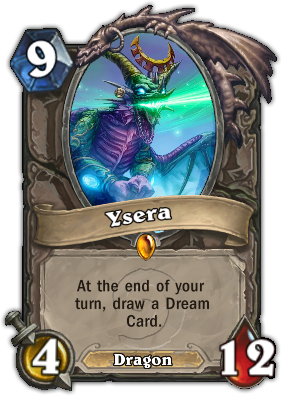 card your opponent must deal with quickly or risk losing the game. These cards should stand on their own and not require a combination of cards to be useful. A common example of this is Ysera. Most of us know that if you don’t deal with your opponent’s Ysera in the first turn or two, your chances of winning the game drastically decrease. Between the advantage gained from the overall power of the Dream Cards and the 4/12 body on the board, things can quickly spiral out of control. Ysera also requires no additional cards to be strong, therefore making it a “threat”.
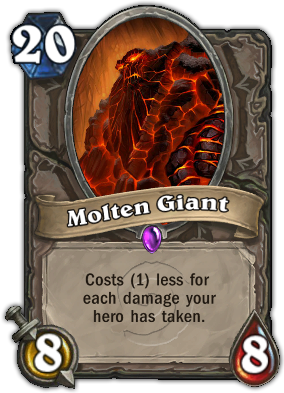
‘Handlock’ generally has a minimum of 7 big threats: 2 Molten Giants, 2 Mountain Giants, 2 Twilight Drakes, and either Alexstrasza, Ragnaros the Firelord, or Leeroy Jenkins. The deck also generally includes at least 1 Faceless Manipulator, which is not inherently threatening on its own, so it won’t be counted in this example.
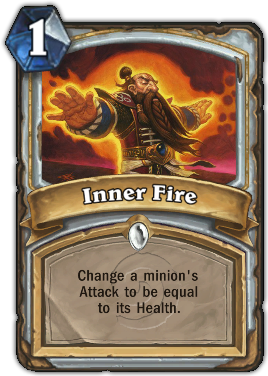
‘Divine spirit, Inner fire’ Priest, however, is built around a one-turn kill, which relies
on drawing at a minimum 1 Inner Fire and 1 Divine Spirit, as well as a minion (who can attack this turn) on which to play it. On it’s own, the deck generally doesn’t have any threats at all.
Even if we went no further in the analysis than this, you can already see why the Priest deck may be inconsistent; on its own there, is no single card that forces your opponent to change their plans. A Mountain Giant played by ‘Handlock’ on turn 4 (going first) will make a Priest no longer drop a Mogu’shan Warden on turn 4, but rather a Shadow Word: Death if available. If not, the Warden becomes 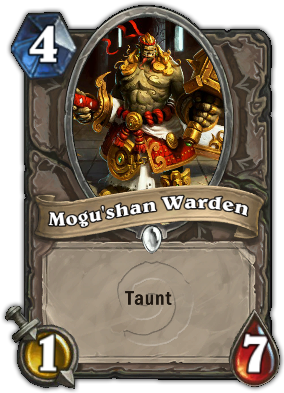 Giant fodder and a lost target for their combo. However, if the Priest drops a Mogu’shan Warden on turn 4 (going first) the ‘Handlock’ doesn’t have to alter their move at all. The Warden on it’s own is no threat to the ‘Handlock’. It only becomes threatening to the ‘Handlock’ and the Mountain Giant, if he has both pieces of the combo in order to deal 14 damage to either the Giant or the Warlock. If the Priest does have both combo pieces, the Warlock will have either lost 14 health making Molten Giants an immediate possibility, or he will have lost 1 of his 7 threats. Either way, if the Warden gets silenced or stalled by a taunt for 1 turn until Siphon Soul can be used, the Priest has effectively reduced their chance of winning dramatically. If the Priest happens to have both divine spirits and an Inner Fire at this point he wins, this is what we call “the dream”, and this is what makes the deck so much fun. Note that it’s called the dream for a reason: it doesn’t happen all the time.
Next, let’s look at board flipping (rather than board clearing, as clearing the board is not always necessary in order to change its state). A Priest generally has 2 ways to flip a board, bot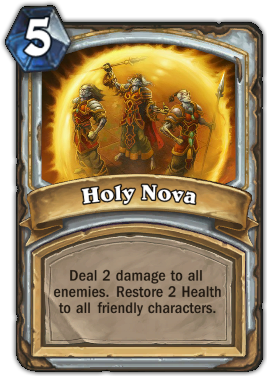 h of which are rather weak. It has 2 Holy Novas, which do 2 damage to all opponents while healing its own side of the board for 2. It also has the Auchenai Soulpriest, Circle of Healing combo which deals 4 damage to all minions. Holy Novas healing ups the mana cost, making it not possible before turn 5 (4 with the coin) and as we already discussed, relying on a combination of cards, like a Circle of Healing clear is never the ideal way of dealing with a board as you need two cards to do it. The Priest deck has very little else in terms of changing the playing field other than Mind Control (swapping the allegiance of your opponents most powerful minion can certainly flip a board), but Mind control costs 10 mana and can often come too late to save you, which is why is it often left out of Priest decks.
‘Handlock’, on the other hand, has both Hellfire and Shadowflame. While Shadow Flame is also a combo card, the difference between it and the Circle of Healing combo is that it can combo with any minion; it is not relying on 2 specific cards. Hellfire deals 1 more damage for 1 less mana than Holy 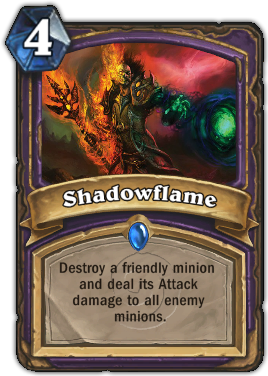 Nova and damages both sides of the board. Shadowflame can theoretically deal up to 9 damage to all enemy minions (a buffed Giant) for the cost of 1 card and 1 minion. ‘Handlock’ has one additional advantage over most decks: the ability to turn a game around by dropping multiple 8/8’s with Taunt. A ‘Handlock’ at low life who drops two Molten Giants and a Sunfury Protector can change the whole board state while not actually clearing any enemy minions. Priest doesn’t really have anything like this in it’s arsenal. Note that the Giants and Sunfury Protector are neutral cards and therefore can be played by any class, yet they don’t fit in most other decks as Warlocks have the best way to control their own life total.
The last thing that makes ‘Handlock’ more consistent than our Priest deck is its draw mechanic This is also why Warlock has what is considered the best hero power. ‘Handlock’ will generally have between 8-10 cards on turn 4, the turn it wants to play its first big threat (Occasionally you see a turn 3 T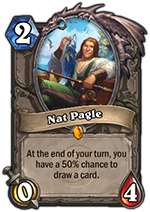 wilight Drake when going second). Due to the powerful nature of the Warlock hero power, the ‘Handlock’ can generate a large hand and can dig through a large portion of its deck without needing to use cards to do it. Other classes who try and generate large card hands generally need to use cards to do so. The Priest will need to play cards like Novice Engineer, Nat Pagle, and Loot Hoarder in order to help facilitate the gathering of the combo cards needed in order to win. It also means that without drawing these cards to help fill its hand, the Priest will at times be playing with a small hand and may be unable to deal with opponents threats. It also limits the amount of threats, removal, or combo targets it can have in the deck. ‘Handlock’ has a full 30 cards at its disposal to both neutralize the opponent as well as play its own destructive force.
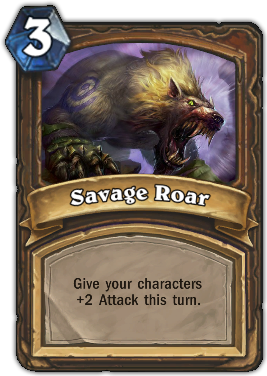 The above decks were used as an example and this article was not meant to compare the ‘Handlock’ vs.‘Inner Fire Priest’, rather to display the struggles of one deck type and the strengths of another. This all being said, combo decks CAN in fact work, they just need to not be 100% reliant on getting the specific perfect combo at just the right time in order to win. Druids can still kill you without the Force of Nature and Savage Roar combo. Warriors don’t need Grommash Hellscream and Cruel Taskmaster (or Slam, or Whirlwind, or a small Shield Slam) to finish you off (they just prefer it).
What does this mean for you when crafting and testing your own decks? Your deck should still be functional if you don’t draw your most important card. ‘Miracle Rogue’ can still win if it doesn’t draw Gadgetzan Auctioneer (Leeroy isn’t the right card to picture here because if the Auctioneer lives you will draw your whole deck including our little charging friend). Control Paladin doesn’t have a single irreplaceable card, especially as people may hold removal all game in order to deal with Tirion Fordring. If your Shaman deck is 100% reliant on an Al’Akir the Windlord and double Rockbiter Weapon combo, you are going to find your deck lacks consistency. Instead,to avoid inconsistency, build your deck with numerous small threats (like ‘Zoo’), a large number of mid-sized threats (like mid-range Hunter), or multiple big threats (like ‘Handlock’ and ‘Ramp Druid’). This way, if you don’t draw a specific card, you can still win.
Dream big, just don’t rely on it.
SIMILAR ARTICLES







You must be logged in to reply to this topic.