








Deck Guide: Aggro Paladin
Author: Joseph Scalise
1. Introduction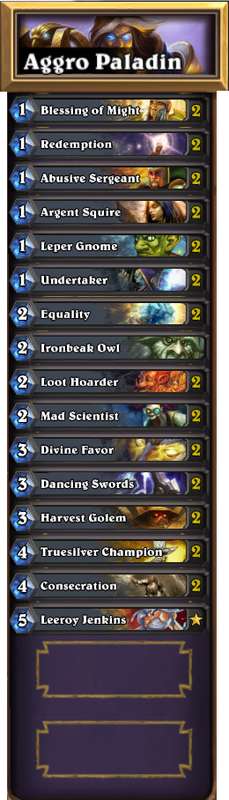
Hearthstone has forever been a game built on the premise of adapt or die. Everytime the meta shifts, sometimes in a matter of hours or days, if you don’t adapt as well the ladder will bury you alive. Well, anyone playing constructed lately knows a giant shift just happened. Miracle Rogue is lamenting the loss of Leeroy Jenkins, and Hunters took a huge hit with the nerf of Starving Blizzard. As an avid deck builder and ladder grinder, as soon as I heard about the changes I started brainstorming about new decks I could play. The above deck list took me up the ladder (currently up to rank four) and I believe it is a great choice for the meta.
It has been a long time since Paladin aggro has had its time in the sun. Shockadin came about in May and led to a resurgence of the deck. It was fast, versatile and had an enormous amount of reach. Since then times changed (as times so often due) and it has all but disappeared. However, now that Aggro Paladin’s number one matchup, Handlock, is back on the ladder I thought this would be a good time to give it a go. This deck came together after relentless testing and is the product of a lot of trial and error. Some of the cards are up for debate (something I will discuss below) but for the most part each card has a set and succinct purpose in the deck.
2. Key Cards
While there are many cards that are rather self explanatory in this list (such as Undertaker or Truesilver Champion) there are some cards that may seem like odd choices. As such,
this section will cover some of the key cards that make the deck work and why they are important to the entire build.
 Argent Squire
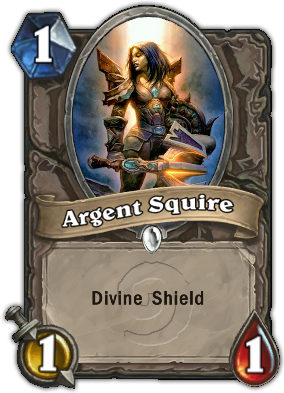
Argent Squire is the first card I want to discuss in this deck. The reason being that many people might question this choice. In terms of aggressive one drops it seems to be completely outclassed by things such as Undertaker or Leper Gnome. However, this card is one of the staples of the deck for a couple of reasons. Not only does it work extremely well with Abusive Sergeant, but it also has the old interaction with Blessing of Might, turning it into a Argent Commander for two mana. This card also works really well with Redemption, and has the extra bonus of being able to trade into a large creature after Equality and live. A very versatile, annoying one drop that I wouldn’t cut for anything.
Redemption
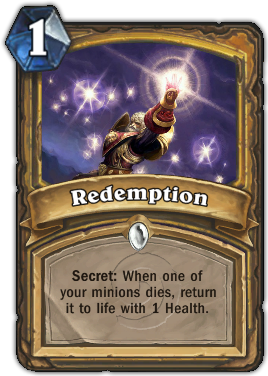 When I first started putting this deck together I knew I was going to be using secrets. At the start I ran Avenge, Redemption and Noble Sacrifice. As time went on, I just found Avenge and Noble Sacrifice to be very underwhelming. However, during that time I also found Redemption to be excellent over and over again. I hit legend with aggro mage last season and that deck taught me a very important lesson in deckbuilding, you only need two secrets to make Mad Scientist worth your time. Using that logic, I cut every secret that wasn’t Redemption and never looked back.
The reason that Redemption is so strong is because it’s not just a value card here: it also serves to be aggressive. Almost any card in the deck gets value out of Redemption, but cards like Loot Hoarder, Harvest Golem, Leper Gnome and Argent Squire just keep the hits coming. It is a fantastic card, and the fact that it’s usually free just makes it even better. I usually mulligan this card to look for Mad Scientists, but it can be a good keep if you have the Coin against something like Druid or Mage (whose hero power can kill your one drops).
Mad Scientist
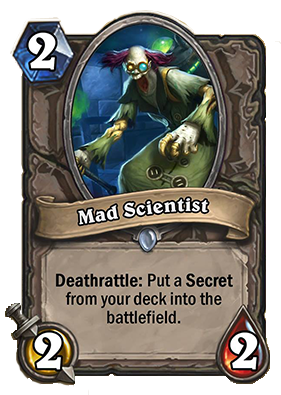 While there are people who don’t like the idea of using Mad Scientist to fetch only two secrets, you really don’t need more targets to make this card work. Yes, there are times where Redemption will sit uncastable in your hand, but that is well worth being able to get it free from your deck. Many times I see people who want to try and take cards like Mad Scientist and only use them if they have a lot of targets. Getting caught up in the ability is a bad idea. Just see this card for what it is, a strong two drop that triggers Undertaker and helps you keep your creatures alive.
Equality/Consecration
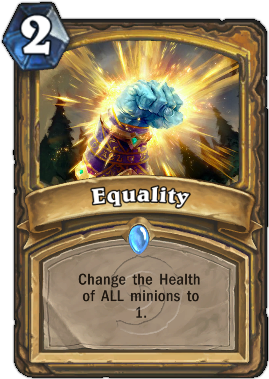 I think one of the main problems with many of the popular aggro Paladin builds I have
seen is that they are trying to stray away from the above combo. Everybody who has played extensive ladder knows how powerful Equality/Consecration is, but it gets even more powerful in this deck. Why? Because each card has its uses separately of the combo. Even though you almost always want to play these two cards together, never be afraid to use Equality to clear a big taunt with one of your creatures (hopefully a Leper Gnome) and never be afraid to use Consecration for damage. This combo is essential to aggro Paladin, and I would never cut it from the deck.
Ironbeak Owl
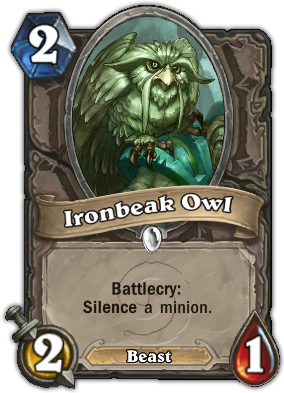 One of the only two one ofs in the deck, Ironbeak owl is an essential card in the current metagame for any aggro deck. While Equality and Abusive Sergeant both help clear taunts to keep pushing damage through, Sludge Belcher is still a nightmare to deal with. Almost every midrange or control deck runs two Belchers, which means you are bound to face one every other game or so. I will keep Ironbeak Owl specifically for the Belchers unless I have a chance to silence something that must be silenced (such as a Tirion or Ancient of War). Since it is a slower card you generally don’t want two of them, but one is very necessary.
Dancing Swords
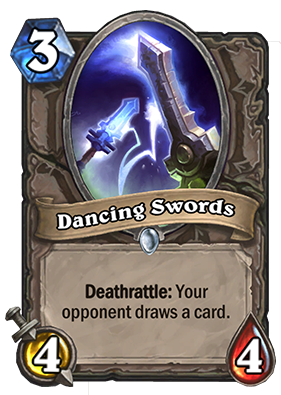 Another card that so far has gotten no love in the past month, Dancing Swords is amazing in this build for multiple reasons. I almost never mulligan this card away when I have the Coin, and usually keep it if I have a one and two drop to go with it. Dancing Swords is exactly what this deck wants, an aggressively costed beater that strengthens Undertaker and helps set up Divine Favor. Paladin has always been a class that has wanted your opponent to draw cards, and a card that also does four damage fits perfectly into this curve. Another way to look at this card, is that it acts very similarly to Death Cultist in Priest, except instead of giving three life on death it does one more point of damage and draws you an extra card down the line.
Divine Favor
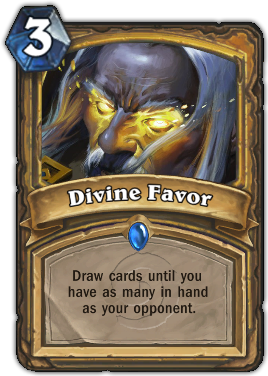 It is an old adage that you are only as strong as your weakest link. Well a truth about this deck is you are only as good as your Divine Favor. While you can easily win games without Divine Favor (happens a lot) setting up this card can easily be the difference between winning and losing. What I mean by that is, don’t just arbitrarily play cards when you have this hand. Always be thinking about what your opponent could play, and their hand size relative to your own. Often times on turn four or five I will use Favor in order to get a couple cards because that’s the best opportunity.
Every deck in the game, control or otherwise, has the ability to dump their hands through cards like Innervate, Soulfire or Whirlwind/Armorsmith/Execute. You need to constantly be aware of when those cards can be played, when they realistically could be played, and then play your Favor around that. Also, a rule of Divine Favor is always to dump your hand as a soon as possible. This is extremely important, and I will even play Truesilver Champion on turn four (even if I’m not going to use it) in order to get the high costs cards out of my hand. Sometimes you have to play cards in sub-optimal ways to draw more cards off of Divine Favor, and that’s ok.
Leeroy Jenkins
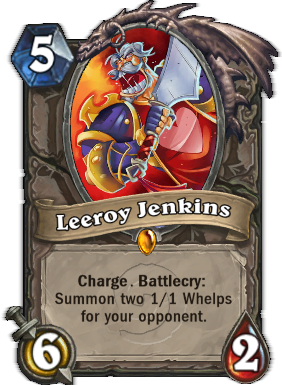 Wait…Leeroy? Yes. Even at five this card is just too strong to cut from the deck. The six damage that he brings to the table almost always happens in the later turns of the game, and at that point the costs between four and five just doesn’t matter. It is unfortunate that
you can no longer go Equality/Consecration into Leeroy, but that is a minor setback that has yet to come up for me. A great aggro card, I just wanted to discuss Leeroy to show that he still absolutely deserves a spot in this deck. Even at five, he has already won me a good number of games.
3. How to Mulligan
Much of the mulligan strategy for this deck was previously discussed in Divine Favor, but I will go into a little more detail here. You want to hit fast and you want to hit hard. The more one drops you have the better, as this allows you to start out quickly and control the board. Controlling the board is the main focus of the early stages of the game, and getting out a wave of creatures usually ensures this. Mulliganing differs from deck to deck (which will be discussed in the matchup section) but you always want to keep Divine Favors against every hero that isn’t Hunter or Warlock. That card can make or break games, and that plus one drops is what you want every starting hand to be. The nature of this deck also makes it so you want a very strong curve. As a result, I will also keep a hand of a one, two, three drop without coin, or two, two drops with coin. You always want something to do on the first three turns of the game.
4. How to Play
While this deck is all about the Divine Favors, is it also about using a plethora of tiny interactions to build up to create a cohesive deck. This deck is built on a ton of small combos (Undertaker/deathrattle, Mad Scientist/Redemption, Argent Squire/Abusive Sergeant, Divine Favor/Dancing Swords) which is what makes it so strong. Always look for value when using this deck, and try to make every play to your advantage. Don’t just play Mad Scientist over Loot Hoarder on turn two, know why Mad Scientist is better. For instance, I will much rather coin out a Mad Scientist against a Warrior than play a turn one Leper Gnome. Why? Because Leper Gnome can be shot by Cruel Taskmaster which loses you board control, whereas they need to have Fiery War Ax to answer Mad Scientist.
Something else to always be aware of is that, this is an aggro deck, but it works much more in the vein of Zoo than it does in the vein of Hunter. What that means is, always control the board. I use Truesilver Champion as minion removal much more than face damage, and spend my first turns clearing out my opponent’s minions while also working to keep mine alive. If you have board presence you are usually winning. Face is good, and you definitely want to whittle away at your opponent’s life total, but make sure they can’t use things like Defender of Argus, or get efficient trades. The main rules of this deck are to always be cognisant of your Divine Favor potential, and never give up board control.
5. Match Ups
 Handlock
As already stated, this matchup is almost laughable. You almost always have an opportunity to do massive amounts of damage early while they help you by lifetapping. Not only that, but every tap helps your Divine Favor. Equality/Consecration is very
strong against their giants, and I will almost always use Equality on turn four to keep them off of creatures to taunt. If they get early Earthen Ring Farseers it can be a little tricky, but for the most part this match is won before it starts.
 Midrange Secrets Mage
Another very simple matchup, Midrange Mage is a deck that is very poorly equipped to handle an aggro rush. They have the ability to take over the game once the later turns start running around, but if you get rolling they usually won’t be able to come back. Mana Wyrm is a problem card, and as such I will always keep Abusive Sergeants in my opening. Besides that, Redemption or Mad Scientist should never be mulliganed here. One note: Similar to Druid, you don’t want to be afraid of the Mage’s hero power. If you have a turn one Leper Gnome, just play it. If they spend their second turn clearing and taking two damage you’re fine with that.
Freeze Mage
Now that Hunters have (mostly) fled to the hills, Freeze Mage has been popping up across the ladder. The one rule of this deck is: Never mulligan Ironbeak Owl away in this matchup. Never. Why? Because, between Deathrattle, Undertaker and Redemption, Doomsayer is the only real answer early answer Freeze Mage has for our deck. While Equality is also a good answer, I try not to keep it as you want to apply pressure and it doesn’t do that. Divine Favor is insanely powerful here, and so are cards like Harvest Golem and Argent Squire. If you can keep up the pressure their secrets usually won’t be able to keep them alive. Also, watch out for Alexstrasza. Nothing is worse than breaking an Ice Block at one life only to have them shoot back to fifteen life.
 Sea Giant Shaman
My own personal thoughts on this deck aside (it sucks), this matchup is entirely based off of the early game. Earthshock has the potential to outright ruin our day, taking out Leper Gnome, Argent Squire while also being able to stop Undertaker and shut off half of Harvest Golem. However, you can’t really play around that card, and if they have it they have it. If you have the choice, always play Leper Gnome turn one over an Argent Squire. Yes, gnome gets hit harder by Earthshock, but if they don’t have it, gnome kills off totems where squire doesn’t.
Lightning Storm isn’t as good as you think (due to the resilience of our minions), but it is something you do have to play around. I will usually keep Truesilver Champion against Shaman and will always keep Argent Squire, as both are ways to deal with Feral Spirit, which is their best card against us. I know I said to always clear the board, but I will always ignore Haunted Creeper unless I can clear all parts of it at once, as it’s just too annoying to deal with. Let them do the trades on that one.
 Face Hunter
Since the nerf I have only seen hyper aggro hunters on the ladder. This match generally falls in our favor, and only gets out of hand if they get an Undertaker rolling of a coin/deathrattle. Ironbeak Owl shuts down many different cards here and should always be kept. Also, since minions are much more important than cards, I mulligan away
Divine Favor here in favor of one drops. This is one of the matches I won’t mulligan away Redemption if I have no Mad Scientist. Yes, they have access to Flare, but that’s a risk you have to take.
 Control Warrior
This is probably the most fifty/fifty matchup on the list. Control Warrior has a ton of anti aggro cards (especially now that they have Death’s Bite) but they also have a lot of hands that do nothing. Your pressure makes it so Shield Slam is really weak, and Execute has very little purpose. With less and less Warriors running both Whirlwind and Brawl, it’s ok to flood the board. Owl does wonders against Belcher (which is their only taunter) but should also be used on an early Armorsmith. Smith is perhaps the best card they have against us, and as such I will always keep Equality here as a way to deal with them easily. Truesilver or Dancing Swords is almost always a must keep here for the same reason.
 Paladin Control
There is no deck in the game that has a worse early game than Paladin Control. Take advantage of this by flooding the board early and beating them down. The only real rule of this matchup is to find the best target for Owl (usually Belcher or Tirion) and to clear out their one/one recruits as often as possible. Turn four is when they are going to be trying to get back in the game through either a sword or Consecration. As such, manage to keep your Undertaker’s and Harvest Golems on three health, and make it so you have as many resilient minions on the board as you can (Redemption doesn’t hurt either). Start fast and beat them before they can get to their healing.
 Deathrattle Priest
The second hardest matchup for Paladin Aggro, Deathrattle Priest is a deck that can be an absolute nightmare. As stated earlier, the strength in this deck is the ability to control the early turns and then use those creatures to blast through for huge chunks of damage. Priest has countless ways to stop this between Zombie Chow, Undertakers, Northshire Cleric and the like. Mulligan aggressively for one drops, but never get rid of Abusive Sergeant or Dancing Swords. Each of those cards allows you to trade up, which takes the advantage away from the Priest.
In addition to the early game, know the amount of healing and combat tricks Priest has access to. Cabal Shadow Priest can target almost everything we have, so I usually try to trade away my value minions (Leper Gnome, Harvest Golem, Loot Hoarder) earlier here than with other matchups. However, while Priest is strong, at the end of the day they really only have two board clears in Holy Nova and Auchenia/Circle of Healing. You can’t always play around these, but if Priest can’t assemble these cards you can overpower them and take them down before they can stabilize. Divine Favor is more key than ever in this matchup, but not worth mulliganing away early minions to try and find.
Zoo
Zoo is by far the hardest matchup to deal with for this deck. They do what we do, but in a way they do it more efficiently, with more minions and Soulfire. The number one rule is to always trade, and do whatever it takes to to get board control. Even though Handlock
is popular, you still have to assume Warlock is going to be Zoo, which means you never want to get rid of Redemption (even if you also have a Mad Scientist). The one advantage you have is that you can snowball just as well as (if not better) than they can. Once you get board control, your hero power usually will make it so you can’t lose it. The hard part is gaining it in the first place. Consecration is excellent here, clearing away most of their annoying creatures. Just make sure to try and drop it before they can play a Defender of Argus.
6. Budget Replacements
This deck is incredibly cheap and only runs one legend (Leeroy). If you don’t have access to the charging chicken lover, or if you just dusted him for a new legend, you could try and replace him with something such as an Arcane Golem or the like. However, every card in this 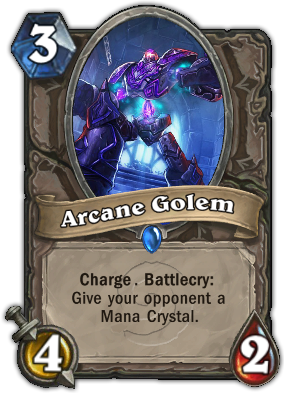 deck has a purpose and I think the deck is much worse without Leeroy. He is probably the only card that can be replaced from the current list, but he should only be replaced due to budget restrictions. The six damage he brings to the table is essential in some games, and losing that would be a huge set back. All the other cards are cheap and help build the core of this deck.
I hope you enjoyed the guide. Let me know what you think in the comments (I always respond) and I hope this brings you success as it has me. Thanks for reading, and until next time when I will discuss my own take on Tempo Rogue, may your Divine Favors always draw seven cards.
SIMILAR ARTICLES








You must be logged in to reply to this topic.